
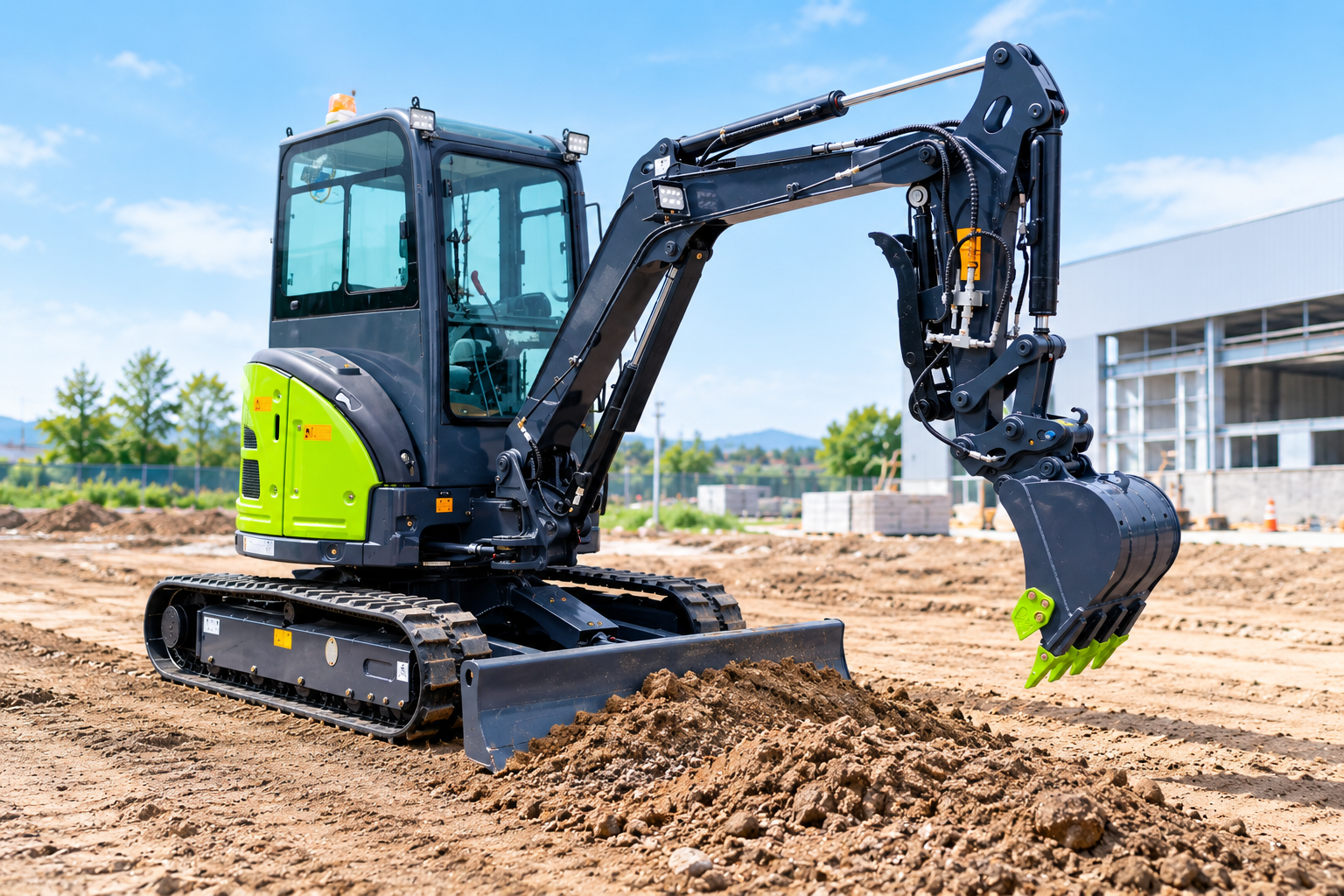
A dozer blade is a practical attachment installed at the front of a mini excavator’s undercarriage.
Although the bucket performs the primary digging work, the blade supports ground leveling, trench backfilling, light material pushing, and site preparation.
By combining excavation and ground handling functions in one machine, a dozer blade helps contractors complete multiple tasks without relying on additional equipment.
It is particularly useful in residential construction, landscaping, drainage installation, and other projects where working space is limited.
1. Ground Leveling and Site Preparation
One of the main functions of a mini excavator dozer blade is to level soil and prepare the working area.
The blade pushes loose soil, sand, and other suitable materials across short distances, helping create a more even surface.
This function is useful when preparing foundations, landscaping gardens, or cleaning up small construction sites.
A relatively level surface can also provide a more consistent working area for subsequent excavation activities.
The effectiveness of leveling depends on blade width, blade angle, soil conditions, and operator technique.
A dozer blade is best suited to light grading and small-scale site preparation rather than precision grading over large areas.
2. Trench Backfilling
After underground pipes, drainage systems, or electrical conduits have been installed, the excavated soil often needs to be returned to the trench.
A dozer blade allows operators to push suitable backfill material into the excavation more efficiently.
Compared with moving soil manually, this approach can reduce labor requirements and shorten site cleanup time.
The excavator bucket can also be used to reposition material when necessary, while the blade helps distribute it across the working area.
However, backfilling should follow project specifications. Where pipes or cables require selected bedding materials or controlled compaction, operators must use the appropriate materials and compaction equipment rather than relying on the blade alone.
3. Supporting Machine Stability During Excavation
A dozer blade can provide an additional support point when lowered onto firm, suitable ground.
During stationary digging, this support may help limit unwanted movement and improve the machine’s working position.
The blade can also help operators establish a more stable position before beginning an excavation task.
This is especially useful when working on uneven but suitable ground, provided the machine remains within its operating limits.
However, the blade does not eliminate the risk of tipping.
Overall stability depends on the excavator’s center of gravity, track configuration, boom and bucket position, ground bearing capacity, and operating conditions.
On slopes or soft ground, operators should follow the manufacturer’s safety instructions and avoid relying on the blade as the sole means of stabilization.
4. Pushing Loose Materials and Clearing Debris
A mini excavator dozer blade can move loose soil, gravel, sand, and small amounts of lightweight debris.
This makes it useful for tidying construction areas, clearing loose material from access routes, and redistributing soil after excavation.
Because the blade is integrated into the machine, operators can switch between digging and pushing tasks without changing attachments. This flexibility is valuable on small jobsites where space, time, and equipment availability are limited.
Nevertheless, the blade is not designed to replace a dedicated bulldozer.
Large rocks, compacted ground, heavy debris, and substantial earthmoving tasks may require specialized machinery or a different work method.
5. Improving Jobsite Productivity
The combination of a digging bucket and a dozer blade allows a mini excavator to perform several related tasks during one work cycle.
For example, an operator can excavate a drainage trench, reposition loose soil, backfill the trench, and level the surrounding area with the same machine.
Reducing equipment changes and unnecessary machine movements can help improve workflow efficiency.
It may also reduce the need to bring separate equipment onto a confined site.
Actual productivity gains depend on soil type, travel distance, jobsite layout, operator skill, and the amount of material being moved.
The blade is most effective when used for short-distance material handling and tasks that complement the excavator’s primary digging function.
6. What Should Buyers Consider When Choosing a Dozer Blade?
When selecting a mini excavator equipped with a dozer blade, buyers should evaluate several factors:
- Blade width:The blade should be suitable for the machine’s size and intended grading tasks.
- Lifting and lowering range:Adequate movement helps accommodate different ground levels and working conditions.
- Ground clearance:Clearance affects the machine’s ability to travel over uneven surfaces and perform various site tasks.
- Machine compatibility:Blade dimensions, mounting structure, hydraulic configuration where applicable, and overall machine design should be compatible.
- Operating environment:Contractors should consider whether the machine will primarily work on soil, gravel, landscaped areas, or confined residential sites.
- Maintenance and durability:Blade wear, mounting points, hydraulic components where fitted, and structural condition should be inspected according to the manufacturer’s maintenance schedule.
The best configuration is not necessarily the largest blade. Instead, it should match the excavator’s operating weight, available pushing capability, and the demands of the intended application.
7. Safe and Effective Dozer Blade Operation
Correct operating technique is essential for achieving consistent results and reducing unnecessary wear. Before operation, the operator should inspect the blade, mounting points, and surrounding work area.
During use, pushing forces should remain within the machine’s operating limits.
Excessive force can increase stress on the blade structure and undercarriage.
Operators should also avoid abrupt movements and exercise caution when working near buried utilities, trench edges, or unstable ground.
When working on slopes, operators must follow the machine manufacturer’s instructions for travel direction, blade positioning, and stability.
A dozer blade should never be used to lift people or unsupported loads, and it should not be treated as a substitute for proper ground compaction or specialized earthmoving equipment.
Routine inspection and appropriate operation help maintain performance and extend the service life of the attachment.
Conclusion
A dozer blade plays an important supporting role on a mini excavator by enabling ground leveling, trench backfilling, light material pushing, and improved positioning during certain excavation tasks.
These functions make the machine more versatile and can help contractors manage small construction projects with fewer equipment changes.
For buyers, choosing a mini excavator with a suitable dozer blade means considering machine size, blade dimensions, operating conditions, and the type of work to be performed.
When correctly matched to the application, this attachment can contribute to a more efficient and organized jobsite.

