
Pilot controls and mechanical controls are two common control systems used in excavators.
Understanding their differences helps buyers evaluate operating comfort, control response, maintenance requirements, and suitability for different working conditions.
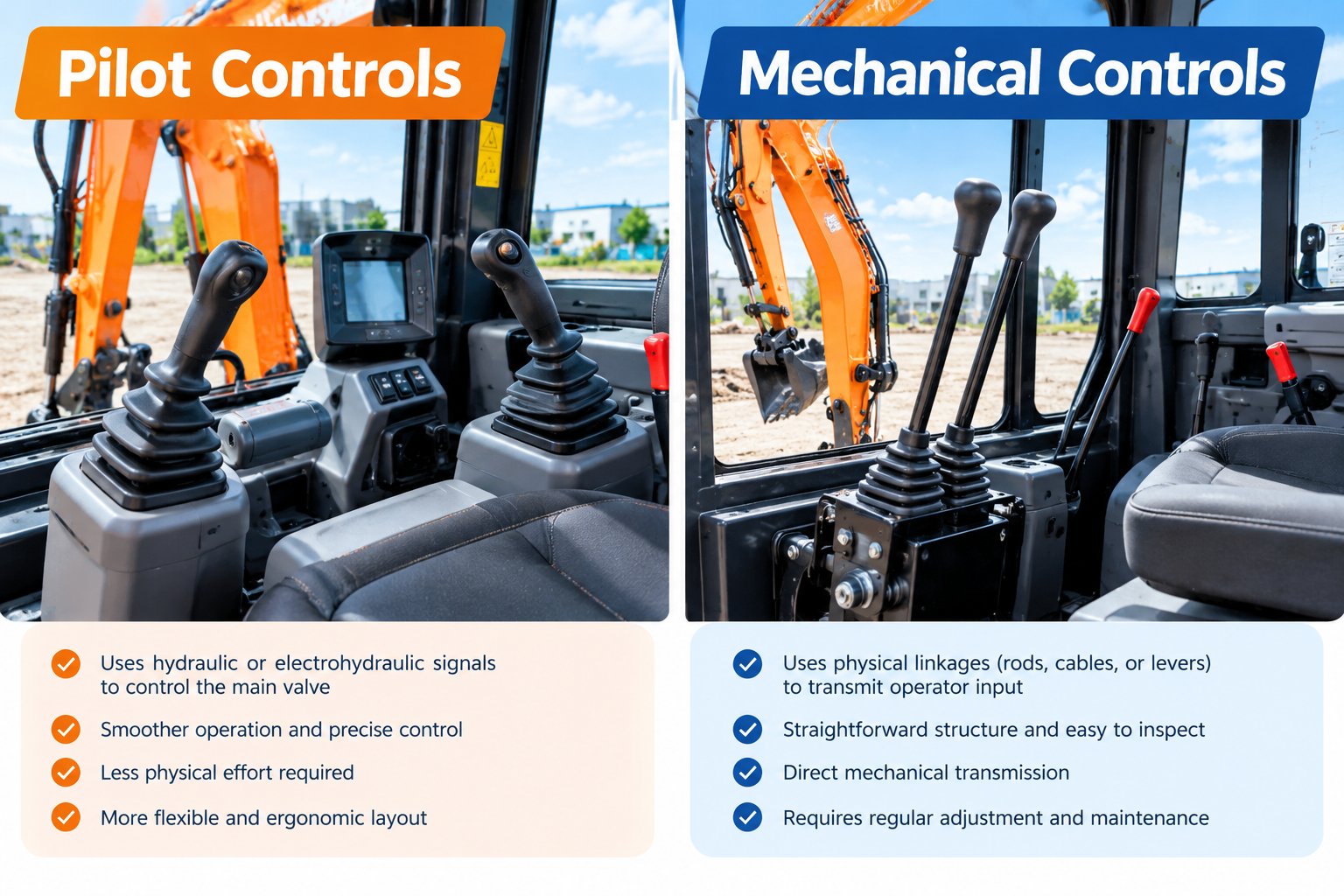
1. What Are Pilot Controls?
Pilot controls use hydraulic pressure or, in some designs, electrohydraulic signals to command the main control valve.
When the operator moves a joystick, the control system directs hydraulic flow to the relevant actuator.
Key advantages:
- Smooth operation: Properly designed systems allow precise movements and controlled operation.
- Reduced operator effort: Joystick operation generally requires less physical force than direct mechanical linkage.
- Flexible control layout: Joysticks support ergonomic operator station designs and intuitive control.
Pilot controls are common in modern excavators, particularly models designed for frequent operation and precise movements.
2. What Are Mechanical Controls?
Mechanical controls use physical linkages, such as rods, cables, or levers, to transmit the operator’s movements to the control mechanism.
Key advantages:
- Straightforward structure:Mechanical linkages can be relatively simple to inspect and understand.
- Direct mechanical transmission:Operator input is transferred through physical connections.
- Simplified maintenance in some designs:Fewer pilot circuit components may reduce certain maintenance requirements.
However, mechanical linkages require appropriate adjustment and maintenance to minimize excessive play, friction, and wear.
3. Key Differences Between the Two Systems
The main difference lies in how operator input reaches the hydraulic control valve.
Pilot controls use hydraulic or electrohydraulic signals, allowing joystick movements to control the main hydraulic system with relatively low operating effort.
Their performance depends on pilot circuit design, valve characteristics, and system calibration.
Mechanical controls rely on physical connections between the operator’s controls and the control mechanism.
Their operating feel and precision depend on linkage design, adjustment, friction, and component condition.
In terms of maintenance, pilot systems require attention to pilot lines, valves, and related components.
Mechanical systems require regular inspection of linkages, joints, cables, and adjustment points.
Neither system is automatically superior in every application.
Overall performance also depends on hydraulic design, component quality, and maintenance practices.
4. How Should Buyers Choose?
When selecting a mini excavator, buyers should consider the intended workload, operator experience, maintenance capabilities, and total ownership cost.
- For frequent operation:Pilot controls may be preferable when reduced operator effort and smooth joystick control are priorities.
- For simpler machine configurations:Mechanical controls may suit buyers who value straightforward construction and accessible maintenance.
- For precision work:Evaluate actual control responsiveness and low-speed movement rather than relying on the control type alone.
- For long-term ownership:Check spare parts availability, service documentation, and the manufacturer’s maintenance recommendations.
Before purchasing, operators should test the machine under representative working conditions and confirm the control system installed on the specific model.
Conclusion
Pilot controls generally prioritize low-effort joystick operation and flexible control, while mechanical controls rely on physical linkages and may offer a simpler control structure.
The right choice depends on machine design, working requirements, operator preferences, and maintenance support.
When comparing mini excavators, buyers should evaluate the complete control and hydraulic systems rather than treating the control method as the sole indicator of performance.

