
A mini excavator is a valuable investment for contractors, construction companies, and equipment rental businesses.
However, the purchase price is only one part of the total cost of ownership (TCO).
Over the machine’s service life, fuel consumption, maintenance, repairs, transportation, and resale value can significantly affect its overall cost.
Understanding these factors helps buyers select the right equipment, manage operating expenses, and improve long-term profitability.
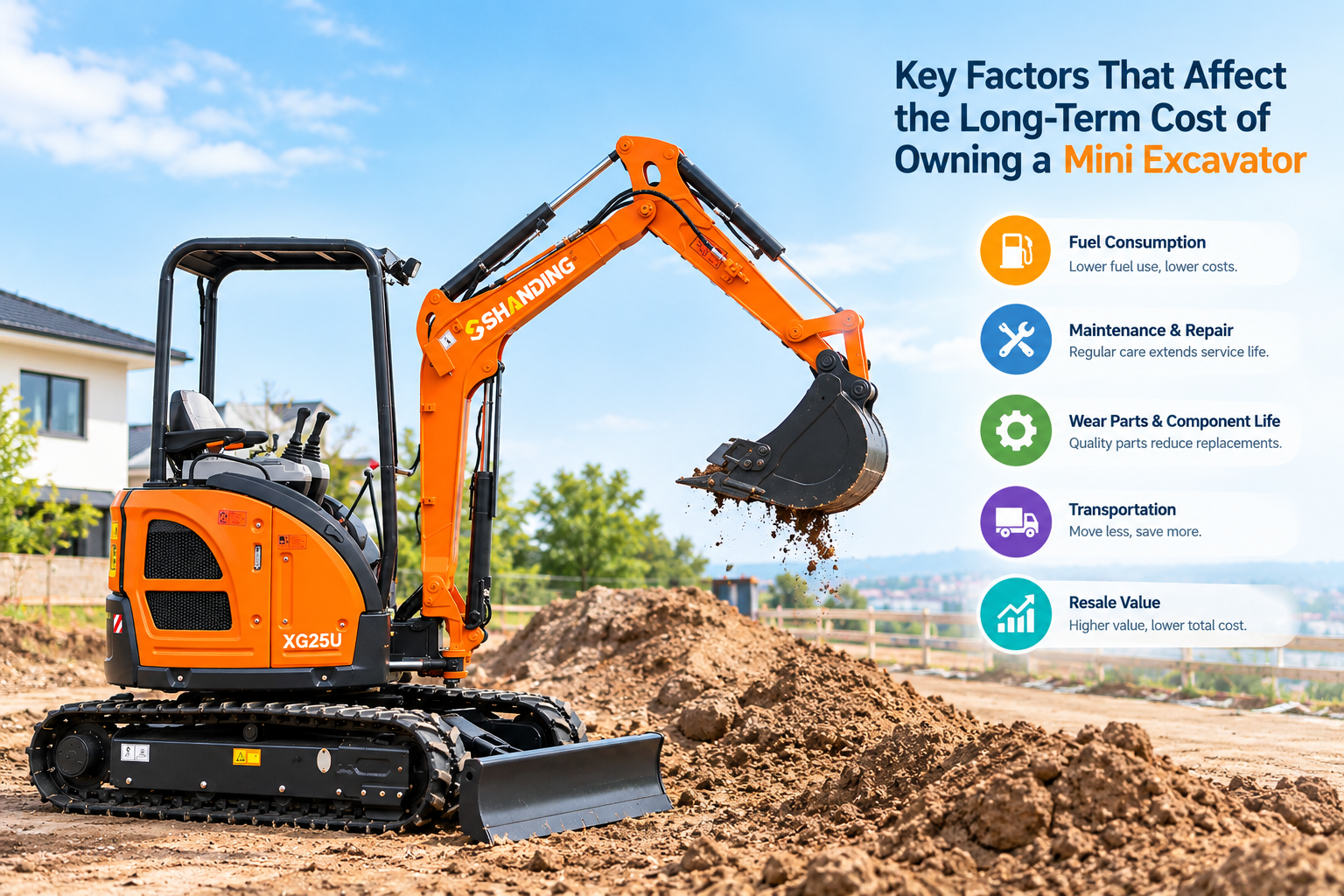
1. Initial Purchase Price and Equipment Specifications
The initial purchase price is an important part of the total investment.
However, choosing a machine based solely on its lowest price may lead to higher expenses later.
Mini excavators with different operating weights, engine power, digging forces, and hydraulic configurations have different costs and capabilities.
Selecting a machine that matches the workload helps avoid unnecessary investment or insufficient performance.
For example, a machine that is too small may require more operating hours to complete a project, while an oversized excavator may increase fuel consumption and transportation costs.
2. Fuel Consumption and Operating Efficiency
Fuel is one of the main recurring expenses during the service life of a mini excavator.
Fuel consumption depends on engine efficiency, hydraulic system performance, workload, operating conditions, and operator habits.
Frequent idling, excessive engine speed, and inefficient digging techniques can increase fuel usage without improving productivity.
A practical way to estimate fuel costs is:
Annual Fuel Cost = Average Fuel Consumption × Annual Operating Hours × Fuel Price
Choosing an appropriately sized machine and maintaining efficient operating habits can help reduce fuel expenses over time.
3. Routine Maintenance and Replacement Parts
Regular maintenance is essential for maintaining machine performance and preventing premature component wear.
Common maintenance tasks include:
- Replacing engine oil and filters at recommended intervals
- Checking hydraulic oil condition and levels
- Inspecting air filters and cooling systems
- Maintaining proper track tension
- Lubricating pins, bushings, and other moving components
- Inspecting bucket teeth and undercarriage components
Maintenance intervals should follow the manufacturer’s recommendations and may need adjustment according to operating conditions.
Preventive maintenance can reduce the risk of major failures and help extend the service life of critical components.
4. Repair Costs and Machine Reliability
Unexpected repairs can significantly increase the long-term cost of ownership.
Hydraulic pumps, travel motors, engines, and undercarriage components may require repair or replacement due to wear, contamination, excessive loading, or inadequate maintenance.
Machine reliability depends on component quality, manufacturing standards, operating conditions, and maintenance practices.
When evaluating a mini excavator, buyers should consider the availability of spare parts, warranty coverage, technical support, and the manufacturer’s quality control procedures.
Reliable equipment can help reduce unplanned downtime and maintain consistent productivity.
5. Operator Skill and Working Conditions
Operator behavior directly affects fuel consumption, component wear, and overall machine efficiency.
Experienced operators generally use smoother control movements, avoid unnecessary travel, and apply appropriate digging techniques. These practices can reduce stress on hydraulic components and the undercarriage.
Working conditions also influence operating costs. Rocky soil, steep slopes, abrasive materials, and continuous heavy-duty operations may accelerate wear and increase maintenance requirements.
Selecting equipment suited to the intended application is essential for controlling long-term expenses.
6. Transportation and Equipment Utilization
Transportation costs should also be considered, particularly for contractors who frequently move equipment between job sites.
The operating weight, transport dimensions, trailer capacity, and local transportation regulations can affect delivery and relocation expenses.
Equipment utilization is another important factor. A mini excavator that operates efficiently for a sufficient number of productive hours can distribute its fixed costs across more completed work.
For rental businesses, utilization rates are especially important because periods of inactivity generate ownership costs without corresponding revenue.
7. Resale Value and Depreciation
Depreciation represents the reduction in equipment value over time.
It is one of the major components of the total cost of ownership.
A mini excavator’s resale value is influenced by:
- Brand reputation and market demand
- Operating hours and maintenance history
- Machine condition and service records
- Availability of replacement parts
- Model popularity and equipment specifications
Well-maintained machines with documented service histories may retain more value in the used equipment market.
Buyers should consider both the expected service life and potential resale value when evaluating different models.
How to Calculate the Total Cost of Ownership
A basic total cost of ownership calculation can help buyers compare different mini excavator models.
Total Cost of Ownership = Purchase Price + Operating Costs + Maintenance and Repair Costs + Transportation Costs − Resale Value
For a more accurate comparison, buyers should evaluate the total cost over the same ownership period and consider annual operating hours.
The cost per operating hour can be estimated as:
Cost per Operating Hour = Total Cost of Ownership ÷ Total Operating Hours
This calculation provides a useful basis for comparing equipment with different purchase prices, fuel consumption rates, and expected service lives.
Conclusion
The long-term cost of owning a mini excavator depends on more than its initial purchase price.
Fuel efficiency, maintenance requirements, machine reliability, operator skills, transportation, utilization, and resale value all contribute to the total cost of ownership.
For contractors and equipment buyers, selecting a mini excavator that matches the intended workload is essential for achieving reliable performance and controlling operating expenses.
Shanding offers a range of mini excavators designed for different construction applications.
By evaluating machine specifications, maintenance requirements, and long-term operating costs, buyers can make more informed equipment investment decisions.

