
A Small Upgrade with a Big Impact
Introduction
Mini excavators have become indispensable machines in construction, landscaping, agriculture, utility installation, and property maintenance. Their compact size and versatility allow contractors to perform a wide range of tasks in confined spaces.
However, the true productivity of a mini excavator often depends on how efficiently it can switch between attachments.
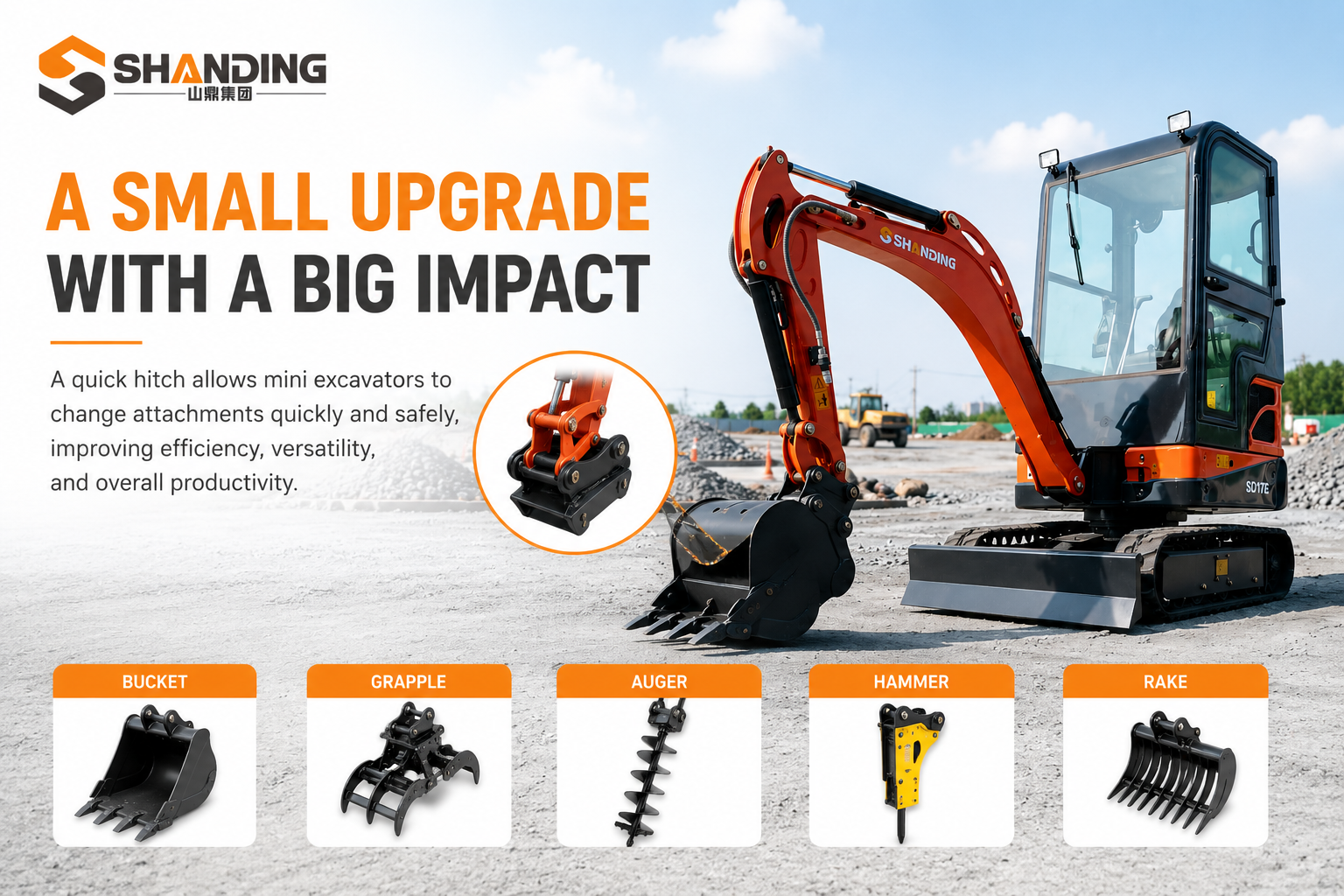
This is where a quick hitch, also known as a quick coupler, plays a crucial role. By allowing operators to change attachments rapidly and safely, a quick hitch transforms a mini excavator into a multi-functional machine capable of completing more work in less time.
In today’s competitive construction environment, maximizing equipment utilization is essential. A quick hitch may seem like a simple accessory, but its benefits extend far beyond convenience.
What Is a Quick Hitch?
A quick hitch is a coupling device installed between the excavator arm and the attachment. Instead of manually removing and installing mounting pins every time a different tool is needed, operators can quickly connect or disconnect attachments using a mechanical or hydraulic locking system.
Modern quick hitches are designed to work with various attachments, including:
- Digging buckets
- Trenching buckets
- Hydraulic breakers
- Augers
- Grapples
- Rippers
- Tilt buckets
- Compactors
With a quick hitch installed, attachment changes that once required significant labor can often be completed in just a few minutes.
1. Dramatically Increased Productivity
One of the primary reasons contractors invest in quick hitches is productivity improvement.
On many job sites, operators frequently switch between attachments throughout the day. Without a quick hitch, each change may require stopping work, removing pins manually, repositioning equipment, and reinstalling hardware.
These interruptions create downtime that directly reduces productivity.
For example:
- Traditional attachment change: 10–20 minutes
- Hydraulic quick hitch change: 30–60 seconds
If an operator changes attachments five times per day, the time savings can easily exceed one hour daily.
Over a year, this translates into hundreds of additional productive operating hours.
From a business perspective, more working hours mean more completed projects and higher revenue potential.
2. Improved Equipment Utilization
Construction equipment generates value only when it is actively working.
Many contractors purchase multiple machines because changing attachments is inconvenient or time-consuming.
A quick hitch allows one mini excavator to perform multiple tasks efficiently, reducing the need for additional equipment.
Instead of using separate machines for:
- Excavation
- Demolition
- Drilling
- Material handling
A single mini excavator can perform all these functions with quick attachment changes.
This improved utilization helps contractors maximize the return on their equipment investment.
3. Enhanced Jobsite Safety
Safety remains one of the most important concerns in modern construction.
Manual attachment changes require workers to enter potentially hazardous areas around the excavator arm and attachment. Risks include:
- Pinch injuries
- Dropped attachments
- Hand injuries
- Foot injuries
- Unexpected equipment movement
Hydraulic quick hitches significantly reduce worker exposure to these hazards.
Many modern systems incorporate:
- Automatic locking mechanisms
- Dual safety locks
- Visual locking indicators
- Hydraulic pressure retention systems
These features help ensure attachments remain securely connected during operation while minimizing the need for manual handling.
A safer workplace often leads to fewer accidents, lower insurance costs, and improved operational efficiency.
4. Reduced Labor Costs
Labor shortages continue to challenge contractors worldwide.
Every minute spent changing attachments manually represents labor that could be used for productive work.
By simplifying the attachment exchange process, quick hitches reduce unnecessary labor requirements.
Benefits include:
- Fewer workers needed during attachment changes
- Reduced operator fatigue
- Faster task transitions
- Lower project labor costs
For companies operating multiple machines, these savings can become substantial over time.
5. Greater Versatility on the Jobsite
Modern construction projects often require machines to perform multiple tasks in rapid succession.
Consider a residential construction project where an operator must:
- Dig a trench
- Break concrete
- Remove debris
- Grade the surface
Without a quick hitch, switching between attachments can disrupt workflow and delay project completion.
With a quick hitch, operators can move seamlessly from one task to another, improving efficiency and responsiveness.
This versatility is especially valuable for:
- Landscaping contractors
- Utility contractors
- Municipal projects
- Agricultural operations
- Rental equipment users
6. Faster Project Completion
Time is money in construction.
The ability to switch attachments quickly helps maintain workflow momentum and reduces delays. Faster project completion offers several advantages:
- Better customer satisfaction
- Increased project capacity
- Improved equipment turnover
- More opportunities for additional contracts
Contractors who complete jobs efficiently gain a competitive advantage in the marketplace.
7. Lower Transportation and Fleet Costs
Because a quick hitch enables one machine to perform multiple functions, contractors may reduce their dependence on specialized equipment.
This can lead to:
- Smaller equipment fleets
- Reduced transportation expenses
- Lower maintenance costs
- Simplified equipment management
For small and medium-sized businesses, these savings can significantly improve profitability.
8. Increased Return on Investment (ROI)
From a financial standpoint, a quick hitch is often one of the most cost-effective upgrades available for a mini excavator.
The return on investment comes from:
- Reduced downtime
- Increased productivity
- Lower labor costs
- Higher equipment utilization
- Faster project completion
Even though a quality hydraulic quick hitch requires an upfront investment, many contractors recover the cost through operational savings within a relatively short period.
Choosing the Right Quick Hitch
When selecting a quick hitch for a mini excavator, consider the following factors:
Machine Compatibility
Ensure the hitch matches:
- Excavator operating weight
- Pin dimensions
- Attachment specifications
Hydraulic or Mechanical Design
Mechanical Quick Hitch
- Lower initial cost
- Simple construction
- Requires manual engagement
Hydraulic Quick Hitch
- Fastest attachment changes
- Greater convenience
- Maximum productivity
Safety Features
Look for:
- Double-locking systems
- Lock confirmation indicators
- International safety compliance
Build Quality
High-quality steel construction and precision manufacturing contribute to longer service life and better reliability.
Why Quick Hitches Are Becoming Standard Equipment
As construction projects become more demanding and labor costs continue to rise, contractors are seeking ways to improve efficiency without increasing fleet size.
Quick hitches address this challenge directly by helping operators:
- Work faster
- Work safer
- Reduce operating costs
- Increase machine versatility
For many professionals, a quick hitch is no longer considered an optional accessory—it has become an essential productivity tool.
Conclusion
A quick hitch may be one of the smallest upgrades you can make to a mini excavator, but its impact can be substantial. By reducing downtime, improving safety, increasing versatility, and maximizing equipment utilization, quick hitches help contractors get more value from every operating hour.
Whether you’re involved in construction, landscaping, agriculture, utility installation, or equipment rental, investing in a quality quick hitch can significantly enhance the performance of your mini excavator and contribute to long-term business success.
At Shanding, we understand that productivity drives profitability. That’s why our mini excavators are designed to support a wide range of attachments and quick hitch systems, helping operators complete more work with greater efficiency and confidence.

