
Choosing the right bucket is essential for getting the best performance from a mini excavator.
Bucket width, capacity, shape, weight, and tooth design all affect digging force, cycle time, material handling, and jobsite efficiency.
The biggest bucket is not always the most productive choice.
The right bucket should match the excavator’s size, the material being excavated, and the type of work.
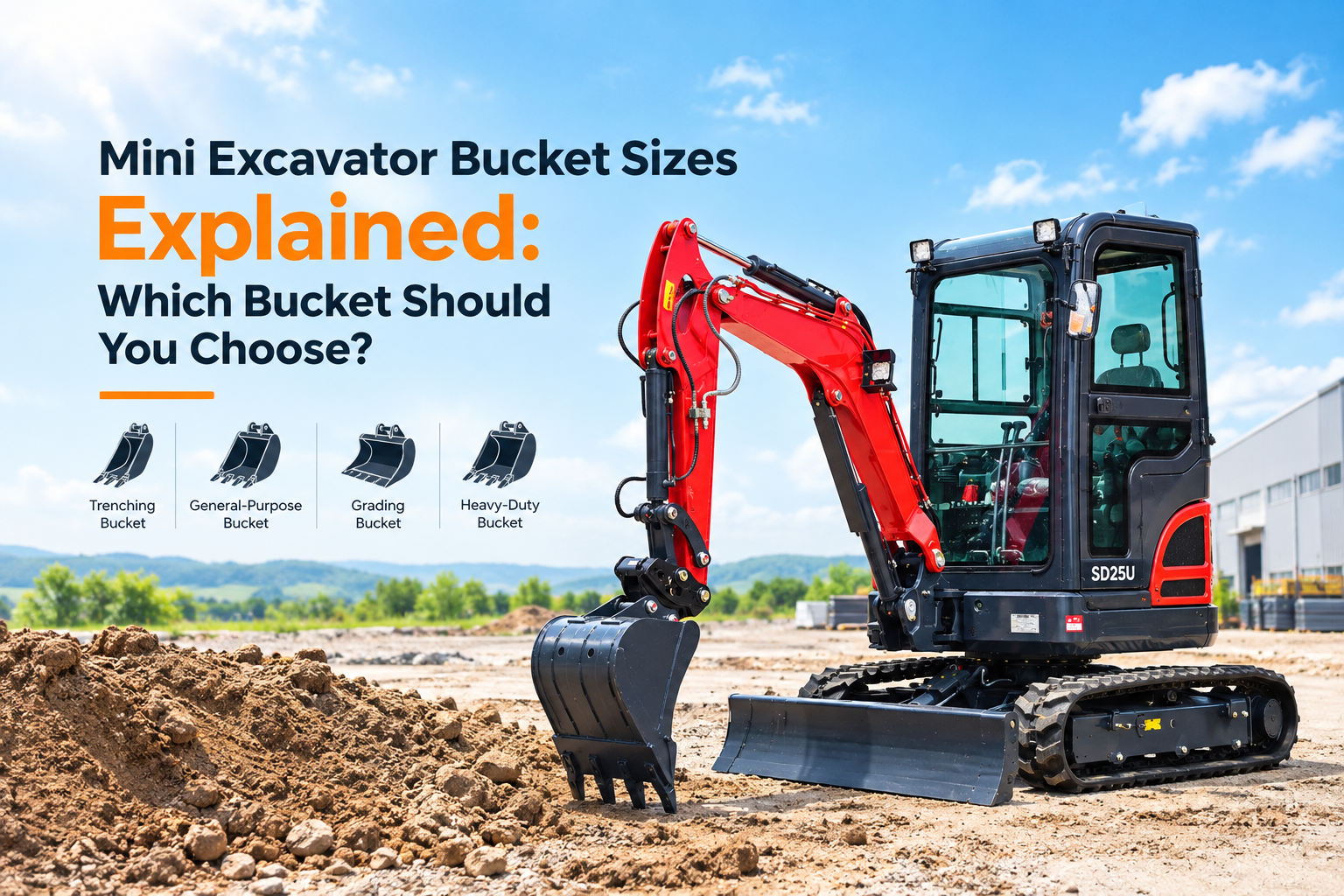
Why Bucket Size Matters
Bucket size directly affects how much material can be moved during each digging cycle.
A wider bucket can carry more loose material and cover a larger area, potentially improving productivity in light soil.
However, a larger cutting edge also requires more breakout force. In dense clay or hard ground, an oversized bucket may be difficult to fill efficiently.
In simple terms:
Larger bucket → greater potential capacity → higher force requirement
Smaller bucket → lower capacity → better penetration and control
Manufacturer-approved bucket dimensions and capacities vary by machine model.
For example, Caterpillar offers mini excavator digging buckets ranging from narrow 9-inch configurations to wider 36-inch options, with capacity changing according to bucket design.
1. Narrow Buckets for Trenching
Narrow buckets are designed for jobs where excavation width needs to be controlled.
They are especially useful for:
- Utility trenches
- Cable installation
- Irrigation
- Drainage
- Small foundations
- Pipeline work
A narrow bucket concentrates the available digging force over a smaller cutting area, which can improve penetration in compact soil.
Bobcat, for example, offers trenching buckets in widths such as 9, 12, 16, 18, and 20 inches for compact excavator applications.
For trenching work, avoid choosing a bucket that is unnecessarily wider than the required trench.
Extra excavation means more soil to remove, handle, backfill, and compact.
2. General-Purpose Buckets for Everyday Digging
A general-purpose bucket is usually the best starting point for a mini excavator because it balances penetration, capacity, and versatility.
It is suitable for:
- General excavation
- Soil removal
- Landscaping
- Foundation preparation
- Backfilling
- Loading loose material
Toothed edges help the bucket penetrate soil, while the bucket profile provides enough capacity for everyday excavation.
For contractors who use a mini excavator across several different jobs, a properly sized general-purpose bucket can provide the best overall productivity.
3. Grading Buckets for Finishing Work
Grading buckets are wider and usually have a smooth cutting edge rather than digging teeth.
They are designed for:
- Leveling
- Final grading
- Backfilling
- Ditch cleaning
- Landscaping
- Surface shaping
Their wider profile allows the operator to move and spread material over a larger area.
However, they are generally not the first choice for breaking compact ground.
Bobcat describes grading buckets as suitable for finish grading, cleaning ditches, backfilling, and leveling.
4. Match Bucket Size to the Material
Soil conditions are just as important as machine size.
For soft soil and loose materials, a larger bucket can increase material moved per cycle.
For dense clay, compacted soil, or harder materials, a narrower bucket is often more effective because it concentrates digging force.
JCB similarly recommends smaller buckets for high-density materials because the reduced cutting area can improve penetration into compact earth.
This means there is no single “best” bucket size for every job.
5. Don’t Ignore Bucket Weight
Bucket capacity is only one part of the selection process.
A larger bucket can also be heavier, and adding a large amount of material increases the working load at the end of the boom.
This can influence lifting performance, stability, hydraulic demand, and cycle efficiency.
Therefore, operators should consider:
- Bucket weight
- Rated bucket capacity
- Material density
- Machine operating weight
- Hydraulic and breakout capacity
- Recommended attachment range
The bucket must remain within the excavator manufacturer’s approved specifications.
6. Check Compatibility Before Buying
A bucket that physically looks suitable may still be incompatible with the excavator.
Before purchasing, confirm:
- Pin diameter
- Pin-to-pin distance
- Dipper/stick width
- Coupler type
- Bucket weight
- Hydraulic requirements for specialty buckets
For pin-on buckets, accurate measurements such as pin diameter, dipper gap, and pin centers are important when confirming compatibility.
If the machine uses a quick coupler, the bucket must also be designed for the specific coupler system.
7. How to Choose the Right Bucket
A practical selection process is:
Step 1: Identify the job.
Determine whether you mainly need digging, trenching, grading, or material handling.
Step 2: Check the material.
Consider whether you are working in loose soil, clay, gravel, or harder ground.
Step 3: Follow the excavator’s specifications.
Check the manufacturer’s recommended bucket sizes and weights.
Step 4: Choose width based on the task.
Use a narrow bucket when excavation width must be minimized and a wider bucket for grading or moving loose material.
Step 5: Consider productivity, not just capacity.
A bucket that is slightly smaller but fills efficiently may outperform an oversized bucket that struggles to penetrate the ground.
Common Bucket Selection Mistakes
Several mistakes can reduce mini excavator productivity:
- Choosing the largest bucket available
- Selecting by width alone
- Ignoring bucket weight
- Using a grading bucket for heavy digging
- Using a narrow trenching bucket for bulk excavation
- Ignoring soil density
- Failing to check coupler and pin compatibility
The objective is not to maximize bucket capacity.
It is to achieve the best balance between digging force, bucket capacity, cycle time, and machine stability.
Conclusion
The right mini excavator bucket depends on the machine, material, and application.
Narrow buckets are ideal for precise trenching, general-purpose buckets provide everyday versatility, and wider grading buckets are better suited to finishing and leveling.
For demanding ground, a smaller bucket can often make better use of the excavator’s available digging force.
For Shanding mini excavators, selecting the appropriate bucket according to the machine’s specifications and intended application can help operators achieve more efficient digging and better overall jobsite performance.

