
When working in narrow construction areas, access and maneuverability can be just as important as digging power.
A mini excavator equipped with a boom swing can move the boom laterally while keeping the machine itself in position, making it easier to work alongside walls, fences, buildings, and other obstacles.
Manufacturers such as Yanmar and Takeuchi specifically highlight boom-swing or offset-boom designs for confined-space and parallel trenching applications.
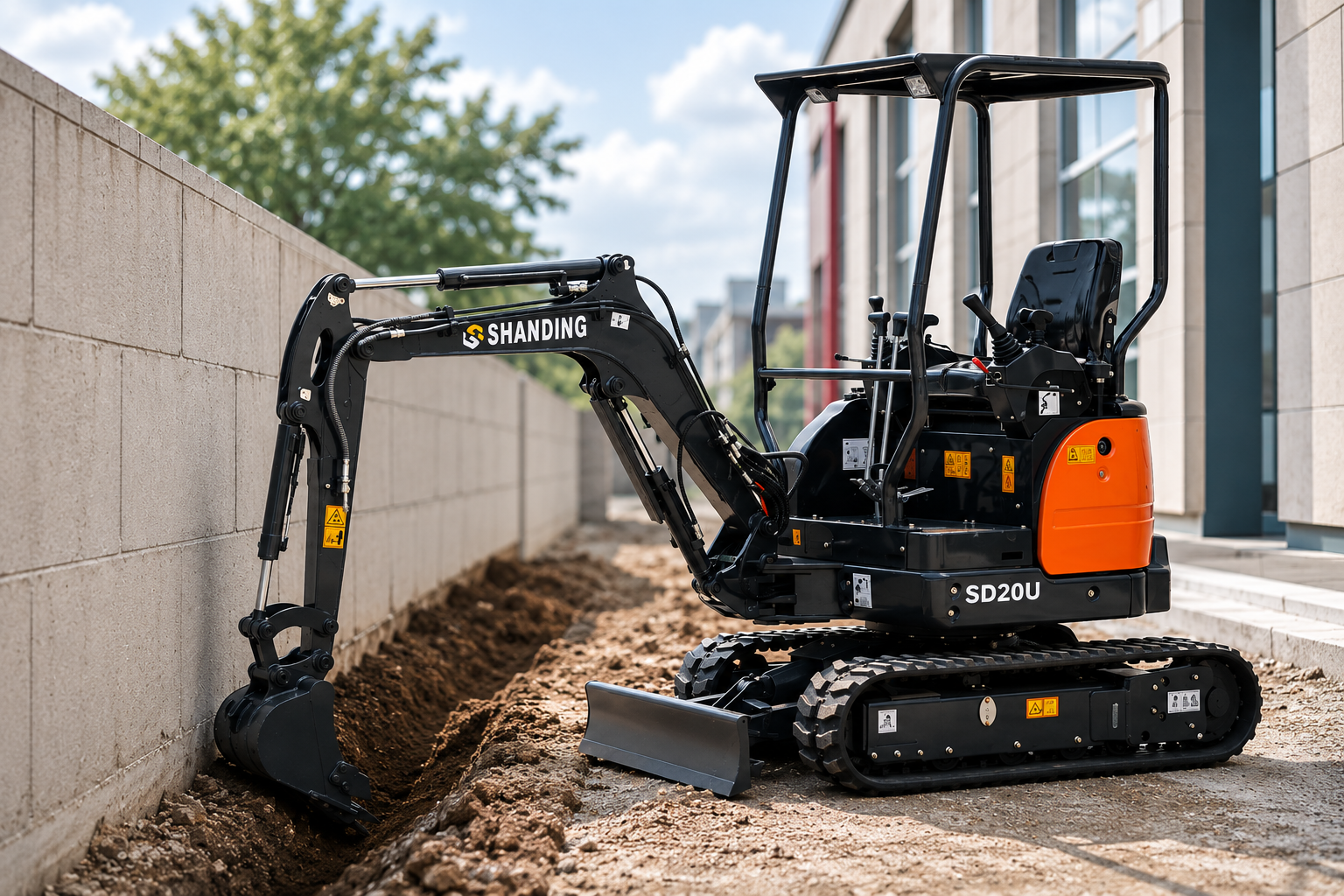
What Is Boom Swing on a Mini Excavator?
Boom swing, also called boom offset or side-to-side boom, allows the front working equipment to move left or right relative to the excavator’s centerline.
This is different from the excavator’s normal upper-body swing. With a conventional swing, the entire upper structure rotates.
With boom swing, the operator can change the digging position while keeping the undercarriage substantially in the same position.
This design is particularly useful when the machine needs to remain parallel to an obstacle.
1. Easier Digging Along Walls and Buildings
One of the biggest advantages is the ability to dig close to walls without repeatedly repositioning the entire machine.
For example, when installing drainage or utility lines beside a building, the operator can position the excavator parallel to the wall and offset the boom toward the excavation area.
This allows the machine to maintain a compact footprint while reaching the required digging position.
Takeuchi describes this capability as useful for parallel trenching directly alongside walls and buildings.
2. Less Machine Repositioning
Without boom swing, operators may need to repeatedly move the tracks to change the digging angle.
Boom swing reduces these repositioning movements:
Position machine → swing boom → dig → return boom
instead of:
Position machine → dig → move machine → reposition → dig again
Fewer repositioning cycles can improve workflow, particularly when digging long trenches or working along fixed structures.
3. Better Performance in Narrow Work Areas
Residential construction, utility installation, landscaping, and road maintenance often provide limited working space.
In these environments, the machine may have enough room to travel forward and backward but not enough room to position itself perpendicular to the excavation.
A swing boom provides another degree of positioning flexibility.
4. Improved Working Around Obstacles
Fences, buildings, sidewalks, retaining walls, and parked vehicles can restrict the excavator’s working angle.
Instead of moving the complete machine every time the digging position changes, the operator can use the boom offset to reach around the obstacle while keeping the tracks in a suitable position.
This can be especially valuable when space is limited but precise digging is required.
5. Works Even Better With a Tight-Tail Design
Boom swing and tight-tail swing solve two different space problems.
- Boom swing:improves front-side working flexibility.
- Tight-tail swing:reduces the rear clearance required when the upper structure rotates.
Combining both features can make a mini excavator highly suitable for confined jobsites.
For example, Yanmar’s compact excavator designs combine boom swing with tight or zero-tail swing specifically to improve maneuverability in restricted areas.
6. Better Choice for Utility and Residential Projects
Boom swing is particularly useful for:
- Utility and cable trenching
- Drainage installation
- Residential construction
- Foundation work beside buildings
- Landscaping
- Road and sidewalk maintenance
- Work alongside retaining walls and fences
The value is greatest when the machine must work close to an obstacle while maintaining a limited footprint.
What to Consider Before Choosing a Swing Boom
Boom swing is not necessary for every application. If most of your work takes place on open construction sites, a conventional boom may provide all the flexibility you need.
Before choosing a swing-boom mini excavator, consider:
- Jobsite width– Can the machine access the work area without repositioning?
- Obstacle proximity– Will you frequently dig beside walls, fences, or buildings?
- Required digging range– Check the manufacturer’s boom-swing angles and working-range specifications for the specific model.
- Machine configuration– Consider boom swing together with tail-swing radius, track width, and overall machine dimensions.
Final Thoughts
A mini excavator’s boom swing is more than an additional feature—it can fundamentally change how the machine operates in confined spaces.
By allowing the boom to move laterally without constantly repositioning the undercarriage, it can improve access, flexibility, and working efficiency.
For contractors regularly working beside buildings, walls, fences, or other obstacles, a mini excavator with the right boom-swing configuration can provide a practical advantage that conventional boom designs may not offer.

