
Transporting a mini excavator between jobsites is a routine task, but improper loading or securing can damage the machine and create serious road hazards.
Safe transportation depends on three factors: the right trailer, correct loading, and proper load securement.
Manufacturer guidance also recommends following the machine’s Operation & Maintenance Manual for transport procedures.
1. Know the Total Transport Weight
Before choosing a trailer, determine the actual weight of the complete load.
Consider:
- Mini excavator operating weight
- Bucket and other attachments
- Quick coupler
- Fuel and accessories
- Any additional tools carried on the trailer
The trailer and towing vehicle must have sufficient rated capacity for the complete combination.
Physical fit alone does not mean the trailer is suitable.
Weight, axle ratings, braking requirements, dimensions, and towing capacity all need to be considered.
2. Choose a Suitable Trailer
A suitable trailer should provide:
- Adequate payload capacity
- Sufficient deck length and width
- Properly rated loading ramps
- Secure tie-down points
- Appropriate brakes and safety equipment
Before transport, also check applicable local, state, and national regulations for weight, width, height, axle loads, and permits. Requirements can vary depending on the transport route and location.
3. Prepare the Loading Area
Loading should take place on a firm, level surface whenever possible.
Connect the trailer securely to the towing vehicle, apply the appropriate parking brake, and prevent unwanted trailer movement.
The ramps should be correctly positioned, locked, and rated for the excavator’s weight.
OSHA also recommends level loading surfaces and appropriate measures to prevent equipment from slipping during loading.
A clear loading area reduces distractions and gives the operator enough room to align the excavator with the ramps.
4. Load the Mini Excavator Slowly
Drive the excavator onto the trailer at a controlled speed.
Keep the machine properly aligned with the ramps and avoid sudden steering movements.
Manufacturer guidance recommends using suitable ramps and loading according to the machine’s operating manual.
Once on the trailer, position the excavator according to the trailer manufacturer’s instructions and the required weight distribution.
The goal is to keep the load stable without creating excessive tongue weight or overloading an axle.
5. Lower the Working Equipment
After positioning the excavator:
- Lower the boom and bucket to the recommended transport position.
- Lower the blade where appropriate.
- Stop the engine.
- Engage the parking brake or applicable safety controls.
- Secure movable components according to the manufacturer’s instructions.
Keeping the working equipment low can reduce unnecessary movement and helps maintain a lower center of gravity during transportation.
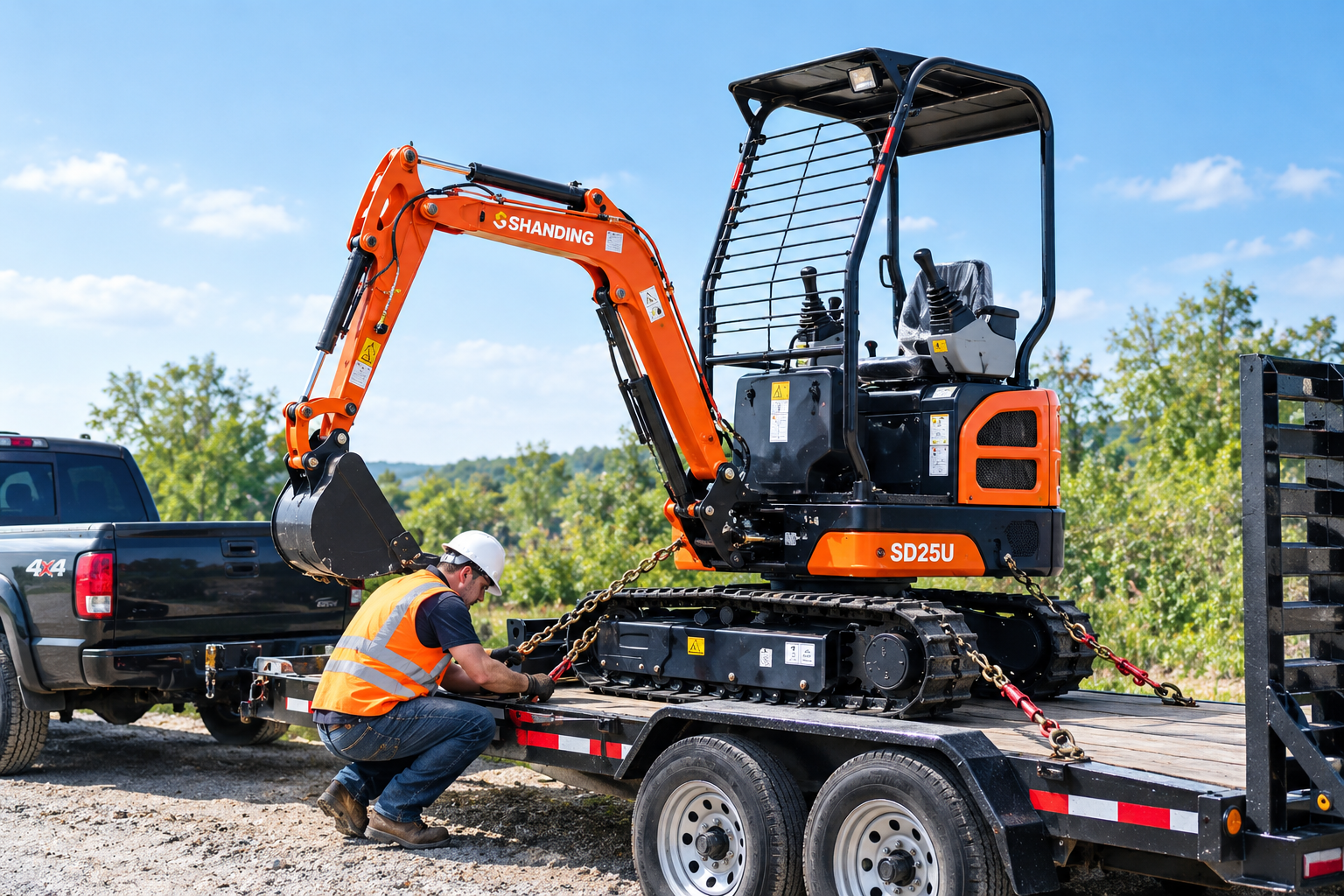
6. Secure the Excavator at Approved Points
A properly positioned excavator still needs to be restrained against movement during braking, acceleration, and cornering.
Use rated chains, binders, straps, or other approved securement devices at the manufacturer’s designated tie-down points.
Multiple tie-downs should be used to restrain the machine in different directions.
Do not attach restraints to hydraulic cylinders, hoses, thin body panels, or other components that are not designed to carry transport loads.
Before departure, inspect the chains or straps for damage and make sure all connections are properly tightened.
7. Secure Attachments Separately When Necessary
Buckets, breakers, augers, grapples, and other attachments are part of the transported load.
If an attachment is not securely connected to the excavator, place it in a stable position on the trailer and secure it independently.
Hydraulic hoses should also be positioned so they cannot be crushed, caught, or damaged during transport.
8. Check the Load Before and During Transport
Perform a final walk-around before leaving.
Check:
- Tie-down tension
- Trailer ramps and locks
- Machine position
- Attachment security
- Tires and brakes
- Lights and reflectors
- Overall height and width
For longer trips, stop at a safe location after the initial period of travel and recheck the securement.
Chains and straps can settle as the machine moves with the trailer.
During transportation, avoid unnecessary sudden braking, sharp turns, and aggressive acceleration.
9. Unload With the Same Care
Unloading should be treated as carefully as loading.
Park on a firm, level surface, secure the trailer, correctly position and lock the ramps, and remove the tie-downs only when the excavator is ready to unload.
Drive slowly down the ramps and maintain controlled movement.
Be especially careful if the destination surface is soft, uneven, or sloped, because machine stability can change as the excavator moves from the trailer to the ground.
Final Thoughts
Safe mini excavator transportation is not simply about getting the machine onto a trailer. It requires a systematic process:
Calculate the load → choose the right trailer → load carefully → position correctly → secure at approved points → inspect → transport → unload safely.
For contractors and equipment owners, following the manufacturer’s transport instructions and applicable road regulations can help reduce equipment damage, transportation risks, and unnecessary downtime.

