
Introduction
Mini excavators have become essential equipment for construction contractors, landscapers, farmers, utility companies, and rental businesses. Their compact size, versatility, and cost-effectiveness make them ideal for a wide range of applications, from residential construction to agricultural maintenance.
However, choosing the right mini excavator is not always straightforward. Many buyers focus only on price or machine size, overlooking factors such as job site requirements, hydraulic performance, operating costs, and future business needs.
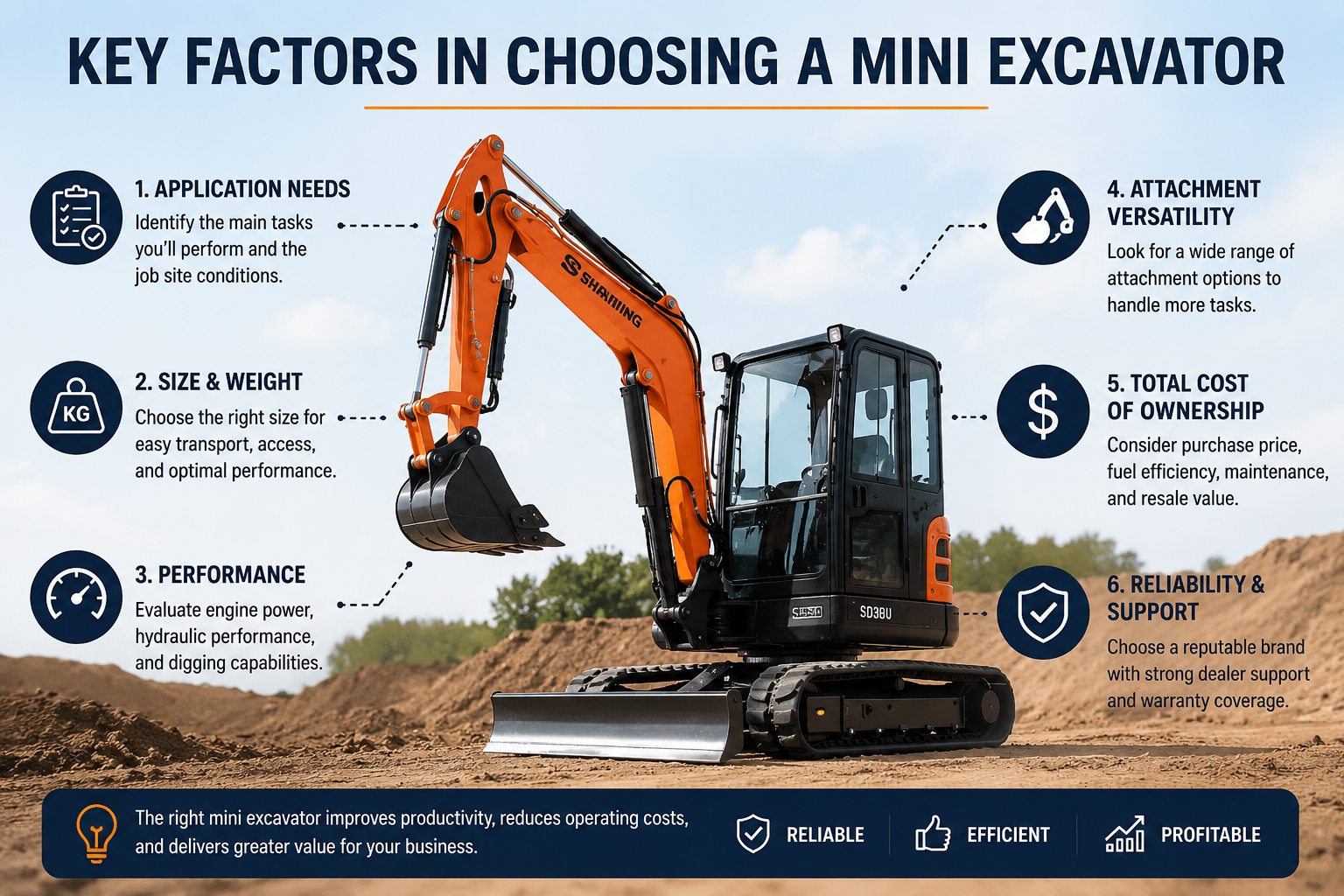
Selecting the correct machine is an investment decision. The right mini excavator can improve productivity, reduce operating costs, and increase project profitability, while the wrong choice can lead to inefficiencies and unnecessary expenses.
This guide explains the key factors to consider when choosing a mini excavator and helps you identify the best machine for your specific applications.
Understand Your Primary Application
The first step in choosing a mini excavator is understanding how the machine will be used.
Different industries have different requirements:
Landscaping
Landscaping contractors often require compact machines capable of working in residential gardens, parks, and narrow spaces. Easy transportation and minimal ground disturbance are important considerations.
Agriculture
Farm owners and orchard operators typically need machines for trenching, irrigation installation, land preparation, and fence construction. Reliability and fuel efficiency are often priorities.
Construction
Construction projects may require deeper digging depths, greater lifting capacity, and enhanced hydraulic performance for demanding tasks.
Utility Installation
Utility contractors frequently work in confined urban environments where maneuverability and precision are critical.
Matching machine specifications to actual job requirements is the foundation of making a smart purchasing decision.
Choose the Appropriate Operating Weight
Mini excavators are generally classified according to operating weight.
1–1.5 Ton Mini Excavators
These compact models are ideal for homeowners, small farms, landscaping projects, and confined work areas.
Advantages include:
- Easy transportation
- Lower fuel consumption
- Excellent maneuverability
- Reduced ground pressure
1.5–2 Ton Mini Excavators
This category offers a balance between compact size and performance.
Suitable for:
- Residential construction
- Utility work
- Landscaping contractors
- General excavation projects
2–3 Ton Mini Excavators
These machines provide greater digging force and lifting capacity while remaining relatively compact.
Ideal for:
- Commercial construction
- Municipal projects
- Rental fleets
- Heavy-duty excavation work
Selecting a machine that is too small may reduce productivity, while choosing one that is too large can increase operating costs unnecessarily.
Evaluate Job Site Conditions
Job site conditions directly influence equipment performance.
Consider the following questions:
- Will the machine operate in narrow spaces?
- Are there buildings, walls, or fences nearby?
- Is transportation between sites frequent?
- Will the excavator work on soft ground or uneven terrain?
For confined spaces, a zero-tail swing design is often the preferred solution because it allows the machine to rotate within its track width without risking collisions.
This design improves both safety and efficiency in restricted environments.
Check Safety and Operator Comfort
Operator productivity is closely linked to comfort and safety.
Features worth considering include:
- Ergonomic controls
- Adjustable seating
- Clear visibility
- Safety lock systems
- Stable machine design
- Easy entry and exit
A comfortable operator can work more efficiently and accurately throughout long shifts, improving overall job site performance.
Why Reliability Matters
Construction equipment frequently operates under demanding conditions.
A reliable mini excavator should offer:
- Durable structural components
- High-quality hydraulic systems
- Stable performance
- Consistent digging power
- Low failure rates
Downtime is one of the biggest hidden costs in equipment ownership. Investing in a dependable machine helps ensure projects stay on schedule and within budget.
Conclusion
Choosing the right mini excavator requires more than comparing prices or machine sizes. Buyers should evaluate their application requirements, job site conditions, hydraulic performance, future attachment needs, operating costs, and long-term reliability.
A carefully selected machine will improve efficiency, increase profitability, and support business growth for years to come.
Whether you are a contractor, dealer, rental company, or farm owner, Shanding offers a complete range of mini excavators designed to meet the demands of modern job sites.
Contact our team today to find the ideal excavator solution for your business.

