
The boom is one of the most important structural components of a mini excavator.
Together with the arm, bucket, hydraulic cylinders, and pivot points, it determines how the working equipment moves through space.
Boom geometry is not simply about making the boom longer or shorter.
Its length, angle, pivot position, and relationship with the hydraulic cylinder affect the machine’s working range, digging depth, lifting height, stability, and force transmission.
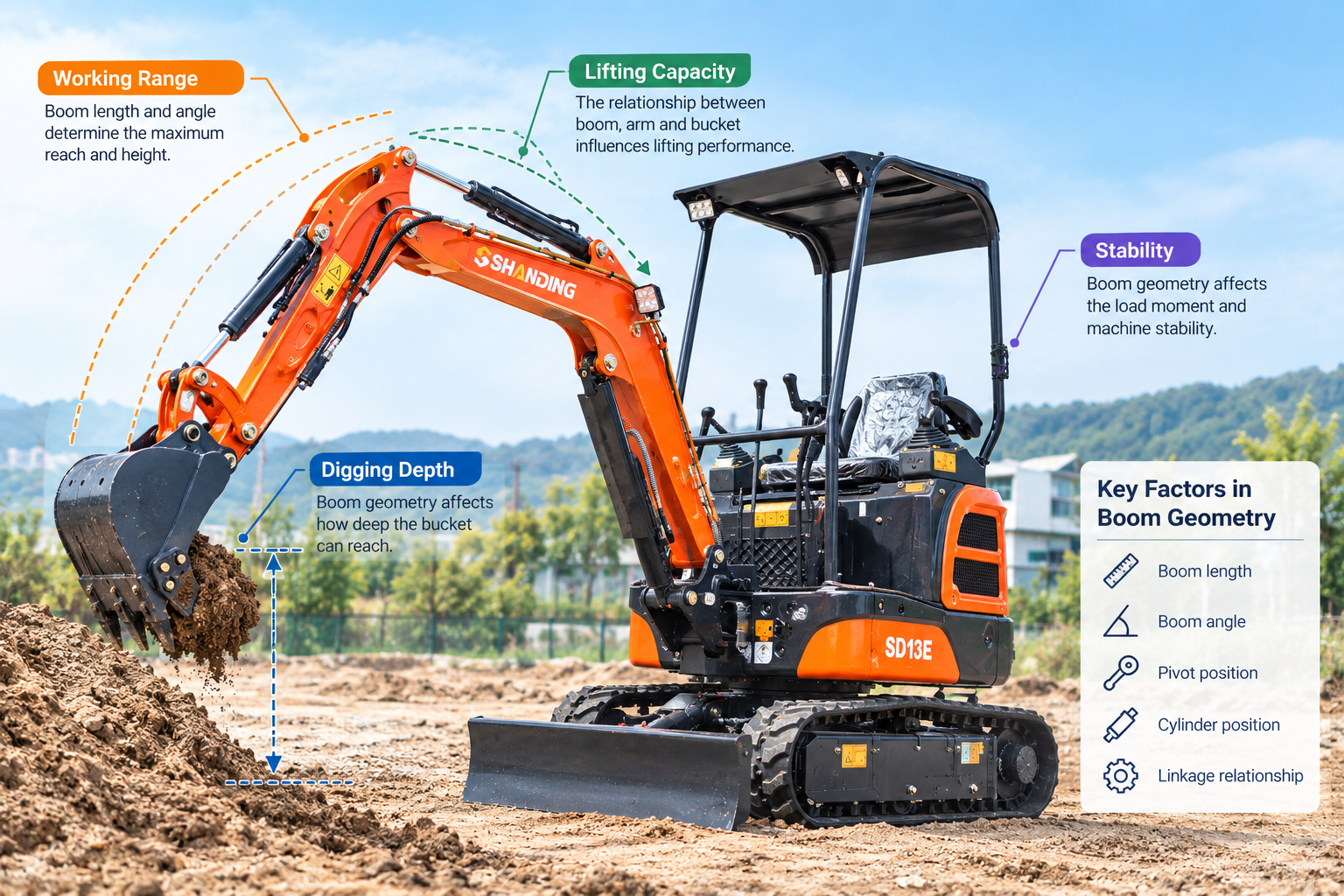
1. Boom Geometry Determines the Working Range
The boom, arm, and bucket form a linked mechanism.
Their joint angles determine the position of the bucket throughout the working cycle.
From a kinematic perspective, changing boom length or boom angle changes the bucket’s reachable workspace.
A properly designed boom can provide an appropriate combination of:
- Maximum digging depth
- Maximum digging reach
- Maximum dumping height
- Maximum cutting height
- Working radius
Engineering studies have shown that increasing boom dimensions can significantly change digging reach and working height, although the actual result depends on the complete working-device geometry.
2. Boom Geometry Affects Digging Depth and Reach
A longer boom can generally extend the working envelope, allowing the bucket to reach farther from the machine and potentially dig deeper.
However, maximum reach does not mean maximum digging performance at every position.
As the boom and arm move through different angles, the mechanical leverage between the hydraulic cylinders and bucket changes.
In simplified terms:
Bucket position = f(boom angle, arm angle, bucket angle, component lengths)
This means the final working range is determined by the combined geometry rather than by boom length alone.
Kinematic analysis of excavator mechanisms uses these joint positions to calculate maximum depth, reach, and height.
3. Boom Geometry Influences Digging Force
Hydraulic pressure creates cylinder thrust, but that thrust must be transferred through mechanical linkages to produce useful digging force.
The relationship can be simplified as:
Output force ≈ Hydraulic cylinder force × Mechanical advantage
Mechanical advantage changes with the position and angle of the boom, arm, bucket, and their connecting cylinders.
Therefore, two excavators with similar hydraulic pressure may produce different digging performance if their working-device geometry is different.
Research on excavator digging mechanisms confirms that force-arm ratios and transmission geometry have a direct relationship with theoretical digging force.
This is also why maximum digging force should not be evaluated separately from the machine’s working position.
4. Boom Geometry Affects Lifting and Stability
The boom also changes the distance between the bucket load and the machine’s center of support.
When the working equipment extends farther from the machine, the load creates a larger overturning moment.
A simplified relationship is:
Moment = Load × Horizontal Distance
Therefore, extending the working range can increase reach but may reduce the available lifting capacity at certain positions.
A well-designed mini excavator must balance reach, digging performance, structural strength, and stability rather than maximize one parameter alone.
5. Hydraulic Cylinder Position Is Also Important
Boom geometry includes more than the steel structure itself. The position of the boom hydraulic cylinder and its connection points also affect machine performance.
Changing the cylinder mounting position changes its required stroke and force transmission characteristics.
Engineering simulation studies have demonstrated that changing the boom-cylinder geometry can alter actuator displacement even when the boom reaches the same working position.
This means manufacturers must coordinate:
- Boom dimensions
- Pivot locations
- Hydraulic cylinder stroke
- Cylinder mounting points
- Working angles
- Structural loads
A good design ensures that the hydraulic system can effectively control the boom throughout its intended working range.
6. Why Boom Geometry Matters in Real Applications
Different applications require different working characteristics.
For trenching, sufficient digging depth and reach are important.
For loading, dumping height and lifting capability become more important.
For landscaping and residential construction, compact working dimensions and precise control may be more valuable.
Therefore, there is no single boom geometry that is ideal for every job.
The objective of mini excavator design is to create a balanced working envelope that matches the intended applications while maintaining adequate hydraulic performance and structural safety.
Conclusion
Boom geometry has a direct influence on how a mini excavator moves, digs, lifts, and reaches. Its dimensions and pivot relationships determine the working envelope, while its interaction with hydraulic cylinders affects force transmission and operating efficiency.
For buyers and operators, maximum reach or digging depth should therefore not be considered in isolation.
A better evaluation considers the complete relationship between boom geometry, arm geometry, hydraulic performance, lifting capacity, and machine stability.
For mini excavators, good boom design is ultimately a balance between reach, force, control, and stability.

