
Mini excavators are widely used in landscaping, construction, agriculture, utility installation, and other projects.
Because different jobs require different attachments, operators often need to switch between buckets, hydraulic breakers, grapples, augers, and other tools.
A quick coupler provides a practical solution by allowing attachments to be changed much faster than traditional pin-on systems.
For contractors who frequently change attachments, a quick coupler can improve machine utilization, productivity, and job-site flexibility.
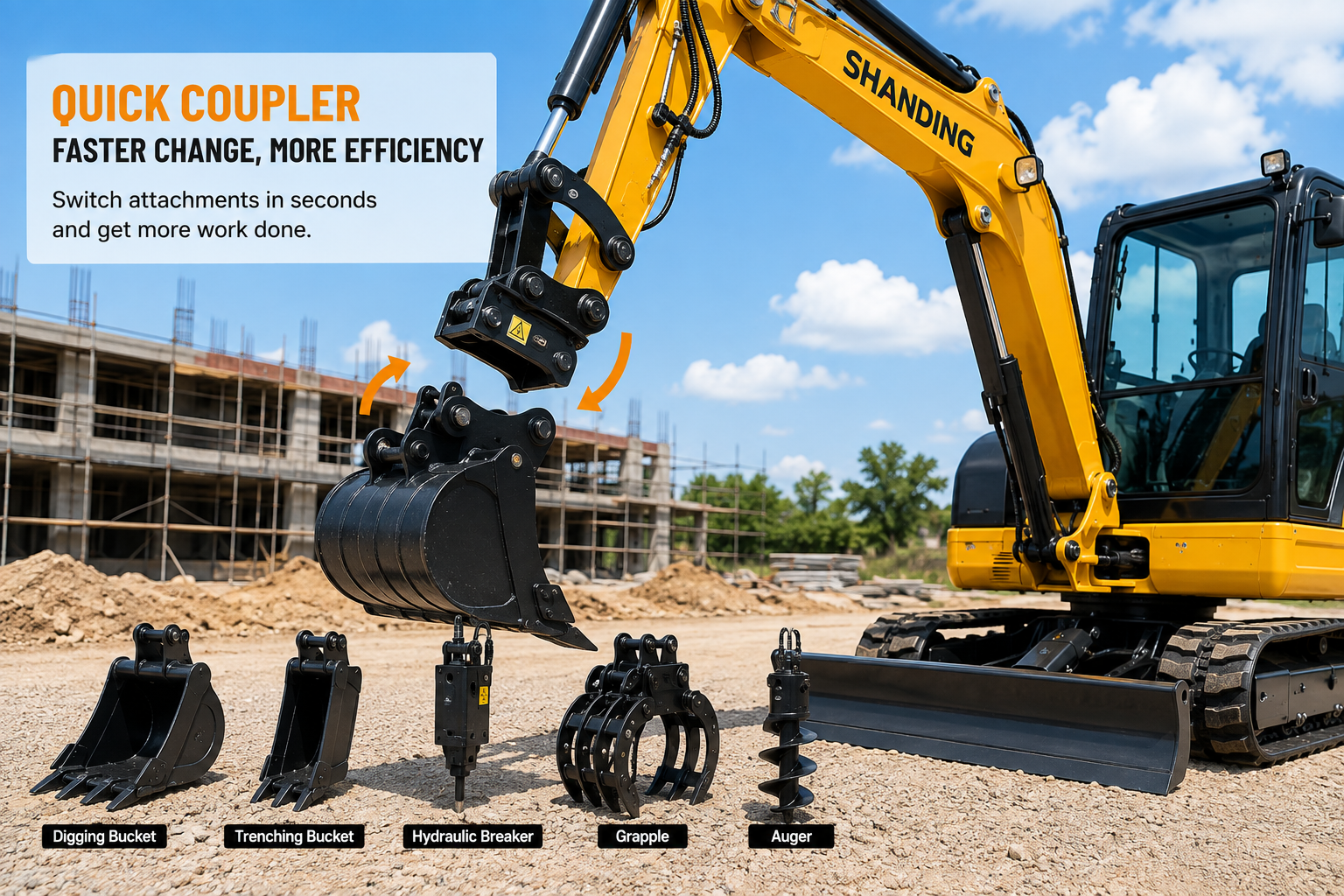
What Is a Quick Coupler?
A quick coupler is a mechanical or hydraulic device installed between the mini excavator arm and an attachment.
It allows operators to connect or release compatible attachments without removing the original mounting pins manually.
Mechanical quick couplers generally require some manual operation, while hydraulic quick couplers can be controlled from the operator’s cab.
Modern hydraulic systems can allow attachment changes without the operator leaving the cab, reducing downtime during multi-task operations.
5 Key Benefits of Quick Couplers
1. Faster Attachment Changes
The biggest advantage is reduced attachment-change time.
A mini excavator may need a digging bucket for excavation, a breaker for concrete, and a grapple for material handling during the same project.
With a quick coupler, operators can switch between compatible tools much more efficiently.
Less time spent changing attachments means more time available for productive work.
2. Higher Machine Productivity
A quick coupler makes it easier to select the right attachment for each task.
For example:
- Bucket for digging and loading
- Hydraulic breaker for concrete and rock
- Auger for drilling holes
- Grapple for handling materials
- Rake or grading attachment for landscaping
Using the correct attachment can improve task efficiency and reduce the need to use one tool for multiple applications.
Manufacturers such as Caterpillar and Bobcat highlight faster attachment changes and improved machine versatility as key benefits of quick-coupler systems.
3. Greater Versatility
One mini excavator can perform many different jobs when equipped with multiple compatible attachments.
This is especially valuable for small contractors who may not want to purchase a separate machine for every application.
A quick coupler allows the same excavator to move more easily between excavation, trenching, demolition, landscaping, and material-handling tasks.
As a result, contractors can potentially increase equipment utilization without significantly expanding their fleet.
4. Improved Operator Convenience
Hydraulic quick couplers can allow attachment changes directly from the cab.
This reduces the need for operators to repeatedly leave the machine and manually handle pins during attachment changes.
It can also make multi-attachment jobs less physically demanding.
However, convenience should never replace proper safety procedures.
NIOSH recommends using manufacturer-approved compatible attachments, performing the required connection test, and verifying that the coupler is properly engaged before operation.
5. Better Long-Term Equipment Utilization
When attachment changes are faster and easier, operators are more likely to use task-specific attachments instead of relying on a single general-purpose bucket.
This can help improve machine utilization and may reduce unnecessary wear caused by using an unsuitable attachment for a particular task. Hydraulic connecting coupler systems are also designed to support faster tool changes and broader attachment use.
Quick Coupler Safety and Compatibility
A quick coupler should always be selected according to the mini excavator’s operating weight, attachment specifications, pin dimensions, mounting geometry, and hydraulic requirements.
Not every quick coupler is universally compatible.
The attachment and coupler must match the excavator’s specifications and the manufacturer’s requirements.
Safety is also critical. A poorly engaged coupler can allow an attachment to detach unexpectedly.
NIOSH identifies improper attachment, mechanical or hydraulic failure, and unsafe operation as major causes of unintended attachment release.
Before operation, operators should:
- Check that the attachment is correctly engaged.
- Follow the manufacturer’s locking procedure.
- Perform the required connection test.
- Inspect the coupler regularly.
- Use only approved and compatible attachments.
- Never stand beneath a suspended attachment.
Is a Quick Coupler Worth It for a Mini Excavator?
For contractors who frequently change attachments, a quick coupler can be a valuable productivity upgrade.
Its main benefits are faster attachment changes, greater versatility, improved operator convenience, and better machine utilization.
For occasional attachment changes, a mechanical coupler may be a practical and economical option.
For operations requiring frequent changes, a hydraulic quick coupler can provide greater convenience and efficiency.
When choosing a system, however, productivity should be considered together with attachment compatibility, hydraulic requirements, machine specifications, and safety features.
Conclusion
Quick-coupler attachments can turn a mini excavator into a more versatile and efficient multi-purpose machine.
By reducing attachment-change time and making different tools easier to use, they help contractors adapt quickly to changing job requirements.
For landscaping, construction, agriculture, utility work, and small demolition projects, the right quick-coupler system can help maximize the value and productivity of a mini excavator.

