
When purchasing a mini excavator, buyers often focus on the initial price tag. However, the true cost of a machine is determined by multiple technical, manufacturing, and market-related factors.
Understanding these variables is essential for contractors, distributors, and construction companies who want to make a cost-effective investment.
Below are the five most important factors that influence the price of a mini excavator, explained from an engineering and industry perspective.
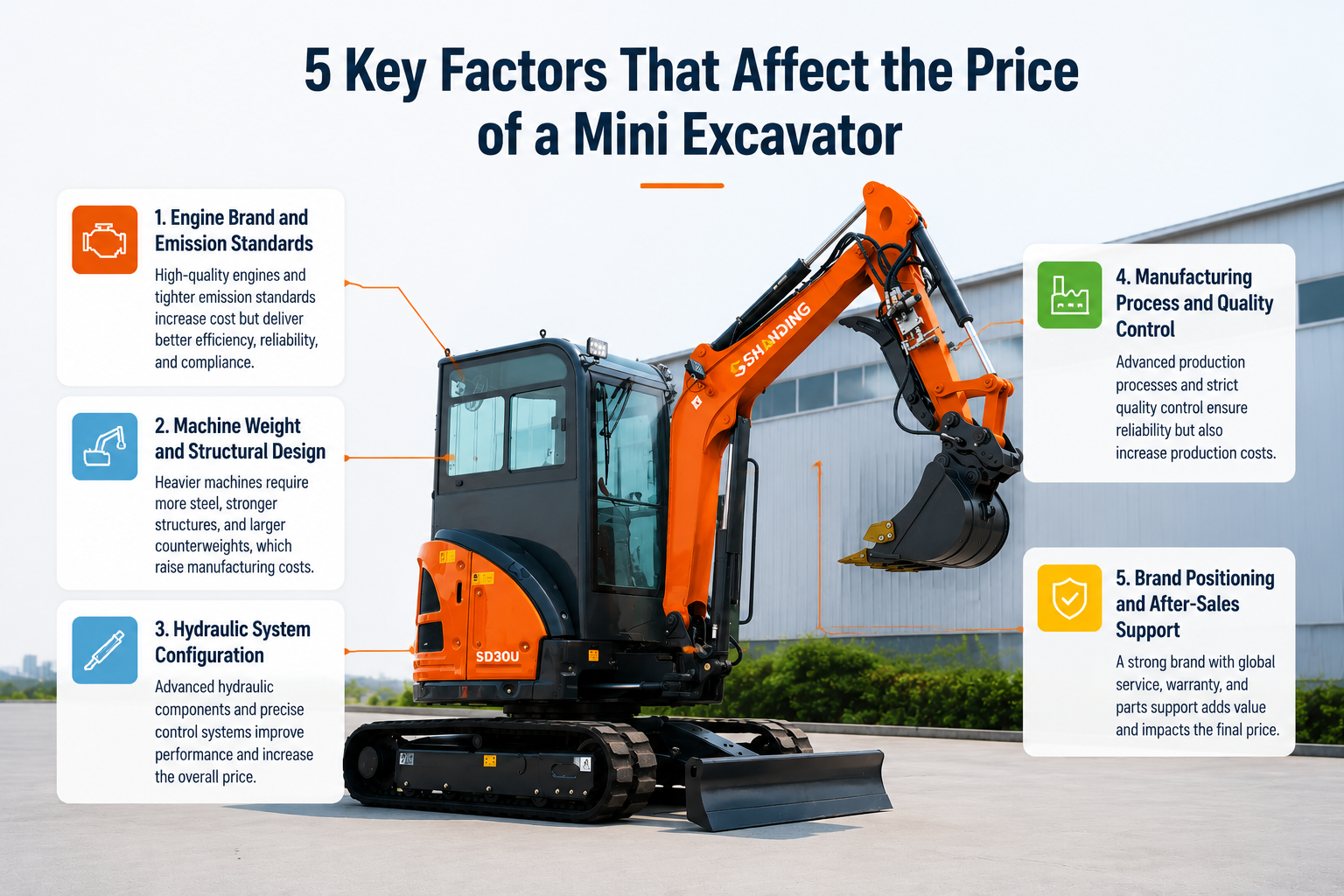
1. Engine Brand and Emission Standards
The engine is the “heart” of a mini excavator, and it is one of the most significant cost drivers.
High-end engine brands such as Yanmar, Kubota, or Perkins generally increase the machine price due to:
- Higher thermal efficiency and fuel economy
- Longer service life and lower failure rate
- Better global after-sales support
In addition, emission standards such as Euro V or EPA Tier 4 also increase cost.
Engines that meet stricter environmental regulations require advanced fuel injection systems, particulate filters, and ECU control modules, all of which raise manufacturing complexity and cost.
From an industrial perspective, emission compliance alone can account for a 10%–25% price difference in otherwise similar machines.
2. Machine Weight and Structural Design
Mini excavators are typically classified by operating weight (e.g., 0.8 ton, 1.8 ton, 3.5 ton, etc.). As weight increases, so does steel usage, hydraulic capacity, and structural reinforcement.
Key cost-related engineering factors include:
- Thicker high-strength steel for boom and arm
- Reinforced undercarriage components
- Larger counterweights for stability
- Increased hydraulic cylinder size
A 3.5-ton excavator may cost significantly more than a 1-ton model not only due to size, but because of exponential increases in material strength requirements and manufacturing precision.
3. Hydraulic System Configuration
The hydraulic system determines the machine’s performance, efficiency, and smoothness of operation.
Price differences are driven by:
- Pump type (gear pump vs. variable piston pump)
- Valve system precision
- Brand of hydraulic components
- Flow control technology
Advanced hydraulic systems allow for:
- Smoother multi-function operation
- Higher digging efficiency
- Reduced energy loss
In engineering terms, hydraulic system quality directly affects cycle time and fuel consumption, making it one of the most performance-sensitive cost factors.
4. Manufacturing Process and Quality Control
Not all mini excavators are built with the same production standards. Factories with advanced manufacturing systems tend to have higher costs but also more stable product quality.
Key manufacturing cost drivers include:
- CNC precision machining of structural parts
- Robotic welding vs. manual welding
- Heat treatment processes for wear resistance
- Full machine load testing before shipment
For example, manufacturers like Shanding implement multi-stage inspection processes, including pressure testing of hydraulic systems and structural stress analysis.
These procedures reduce failure rates but increase production time and cost per unit.
5. Brand Positioning and After-Sales Support
Brand value is an often underestimated but critical pricing factor.
A well-established brand can command higher prices due to:
- Global dealer networks
- Spare parts availability
- Warranty policies (12–24 months or more)
- Technical training and support services
From a market economics perspective, brand premium reflects not only product quality perception but also reduced risk for the buyer. Customers are often willing to pay more for reliability and long-term service assurance.
Conclusion
The price of a mini excavator is not determined by a single factor, but by a combination of engineering design, component selection, manufacturing standards, and brand value.
To summarize:
- Engine quality defines efficiency and compliance cost
- Machine size determines material and structural investment
- Hydraulic system affects performance and technology level
- Manufacturing process ensures consistency and reliability
- Brand value adds trust and long-term service assurance
For buyers, understanding these factors helps avoid choosing solely based on price, and instead focus on total value and long-term return on investment.

