
China has become an important source of mini excavators for construction companies, equipment dealers, and rental businesses worldwide. Chinese manufacturers offer a wide range of models, configurations, and price options.
However, purchasing a mini excavator from overseas requires more than comparing prices.
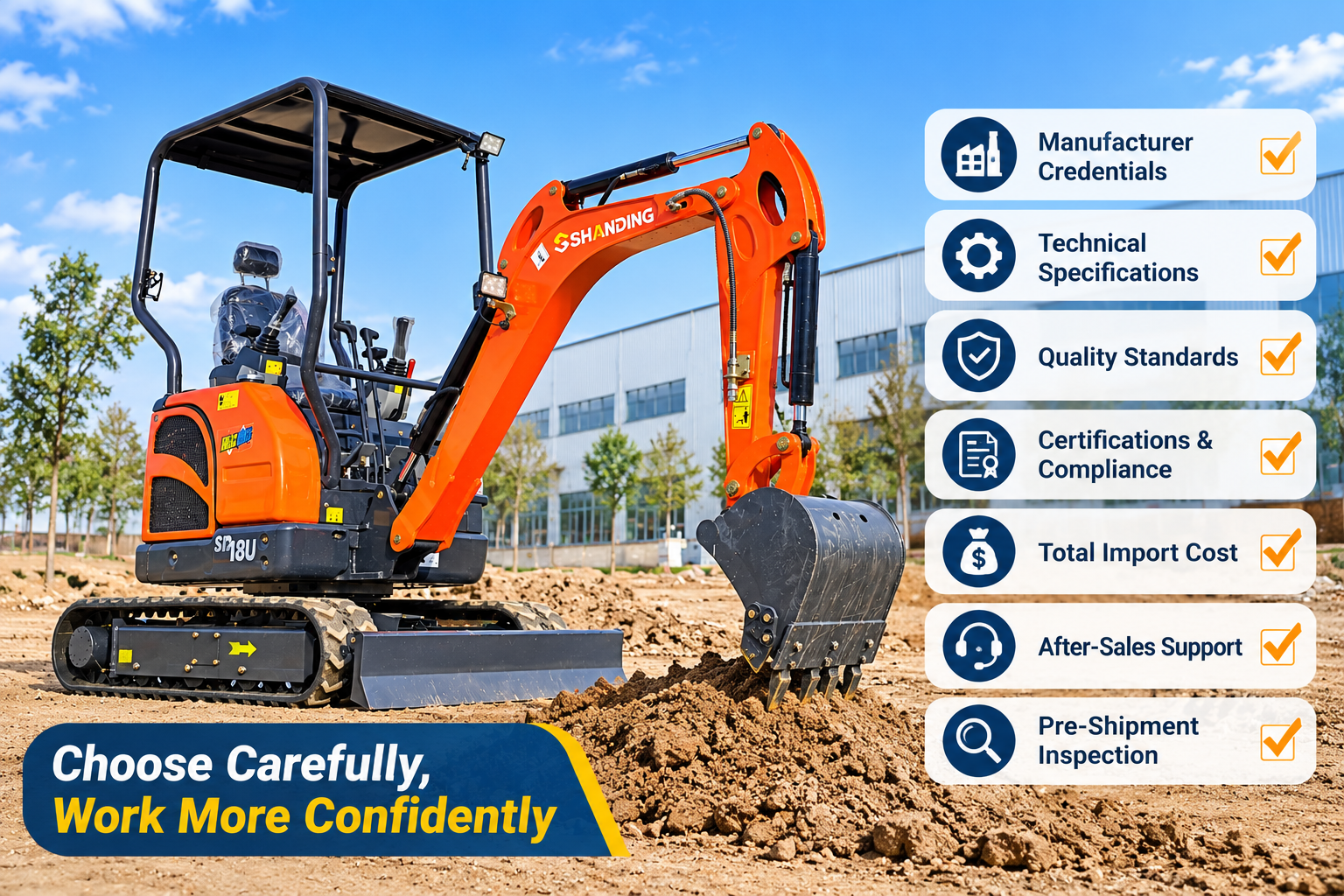
Buyers should evaluate machine specifications, manufacturing quality, supplier reliability, shipping arrangements, and after-sales support to make an informed decision.
1. Verify the Manufacturer’s Credentials
Before placing an order, verify the supplier’s business registration, manufacturing capabilities, and export experience.
A reliable manufacturer should be able to provide company information, factory details, product documentation, and evidence of quality management practices.
If possible, request a factory inspection or a live video tour to confirm production capabilities.
For distributors and importers, establishing a direct relationship with a manufacturer can also improve communication, product consistency, and long-term supply planning.
2. Compare Technical Specifications
Mini excavators are available in different operating weights, engine configurations, and working dimensions. Buyers should compare specifications based on their intended applications rather than focusing only on the machine’s nominal tonnage.
Important specifications include:
- Operating weight and overall dimensions
- Engine brand, rated power, and applicable emission standards
- Maximum digging depth and digging reach
- Bucket digging force and arm digging force
- Hydraulic system pressure and flow rate
- Track width and ground clearance
These parameters determine whether a machine can perform efficiently under specific working conditions.
For example, a compact machine may be suitable for residential landscaping, while a heavier model may provide better stability for demanding excavation tasks.
Always request an official specification sheet and confirm that the quoted configuration matches the actual machine.
3. Evaluate Manufacturing Quality
The quality of a mini excavator depends on its structural design, material selection, manufacturing processes, and component assembly.
Pay particular attention to the following areas:
- Structural components: Inspect the boom, arm, chassis, and welding quality.
- Hydraulic components: Check the hydraulic pump, control valves, cylinders, and hose connections.
- Engine and powertrain: Verify the engine model and the compatibility of major components.
- Undercarriage: Evaluate track quality, rollers, sprockets, and tensioning mechanisms.
Consistent manufacturing quality helps reduce premature wear, unexpected downtime, and long-term maintenance costs.
Buyers should request inspection records, component details, and machine test reports whenever available.
4. Check Certifications and Compliance Requirements
Import regulations vary by destination country. A mini excavator that meets the requirements of one market may not automatically comply with another.
Before purchasing, confirm the applicable requirements for:
- Engine emissions
- Machinery safety
- Product documentation
- Import customs procedures
- Local registration or operating requirements, where applicable
For example, buyers importing equipment into the European Union should verify the machinery safety and engine emission requirements applicable to the specific machine and its intended market.
Request relevant declarations, certificates, and technical documents from the manufacturer.
Do not assume that every model or configuration has the same compliance status.
5. Understand the Total Import Cost
The purchase price is only one part of the total cost of importing a mini excavator from China.
A complete cost assessment should include:
- Machine price and optional equipment
- Inland transportation in China
- Export documentation and customs clearance
- Ocean freight and marine insurance
- Import duties and applicable taxes
- Destination port handling and inland delivery
The final landed cost depends on the destination country, shipment size, trade terms, and local regulations.
Comparing suppliers using the same delivery terms, machine configuration, and included services provides a more accurate basis for purchasing decisions.
6. Confirm Spare Parts and After-Sales Support
Reliable after-sales support is essential for overseas equipment buyers. Delayed replacement parts or limited technical assistance can increase machine downtime and operating expenses.
Before placing an order, ask the supplier about:
- Availability of commonly used spare parts
- Parts ordering procedures and delivery lead times
- Technical support and troubleshooting resources
- Warranty coverage and claim procedures
- Maintenance manuals and operating instructions
For equipment distributors, a dependable spare parts supply is particularly important because it directly affects customer satisfaction and business reputation.
7. Inspect the Machine Before Shipment
A pre-shipment inspection helps confirm that the delivered machine matches the agreed specifications and quality requirements.
A practical inspection should include:
- Verifying the model, serial number, and configuration.
- Checking the engine, hydraulic system, and major structural components.
- Testing travel, swing, digging, and auxiliary hydraulic functions.
- Inspecting for oil leaks, abnormal noise, or unusual vibration.
- Confirming the included attachments, tools, and documentation.
- Taking photographs and videos for shipment records.
For larger orders, buyers may consider third-party inspection services to provide an additional level of quality assurance.
8. Choose a Manufacturer for Long-Term Cooperation
The right mini excavator supplier should provide more than competitive pricing.
Manufacturing consistency, technical communication, spare parts availability, and delivery reliability all contribute to a successful long-term partnership.
For equipment dealers and importers, these factors can influence customer retention, operating costs, and future purchasing decisions.
Shanding offers a range of construction machinery, including mini excavators, wheeled excavators, and loaders.
Buyers can evaluate the available models and configurations according to their project requirements and local market needs.
Conclusion
Buying a mini excavator from China can be a practical investment when the supplier and machine are carefully evaluated.
By checking manufacturer credentials, technical specifications, manufacturing quality, compliance requirements, total import costs, after-sales support, and pre-shipment inspection procedures, buyers can reduce purchasing risks and make more confident decisions.
For overseas contractors, distributors, and equipment importers, selecting a reliable manufacturer is an important step toward building a sustainable equipment business.

