
Mini excavators are widely used in construction, landscaping, utility installation, and property maintenance.
Their versatility depends not only on machine performance but also on the attachments selected for different tasks.
The right mini excavator attachments can improve productivity, reduce manual labor, and expand the range of projects a single machine can handle.
However, attachment selection should be based on the machine’s operating capacity, hydraulic specifications, and job requirements.
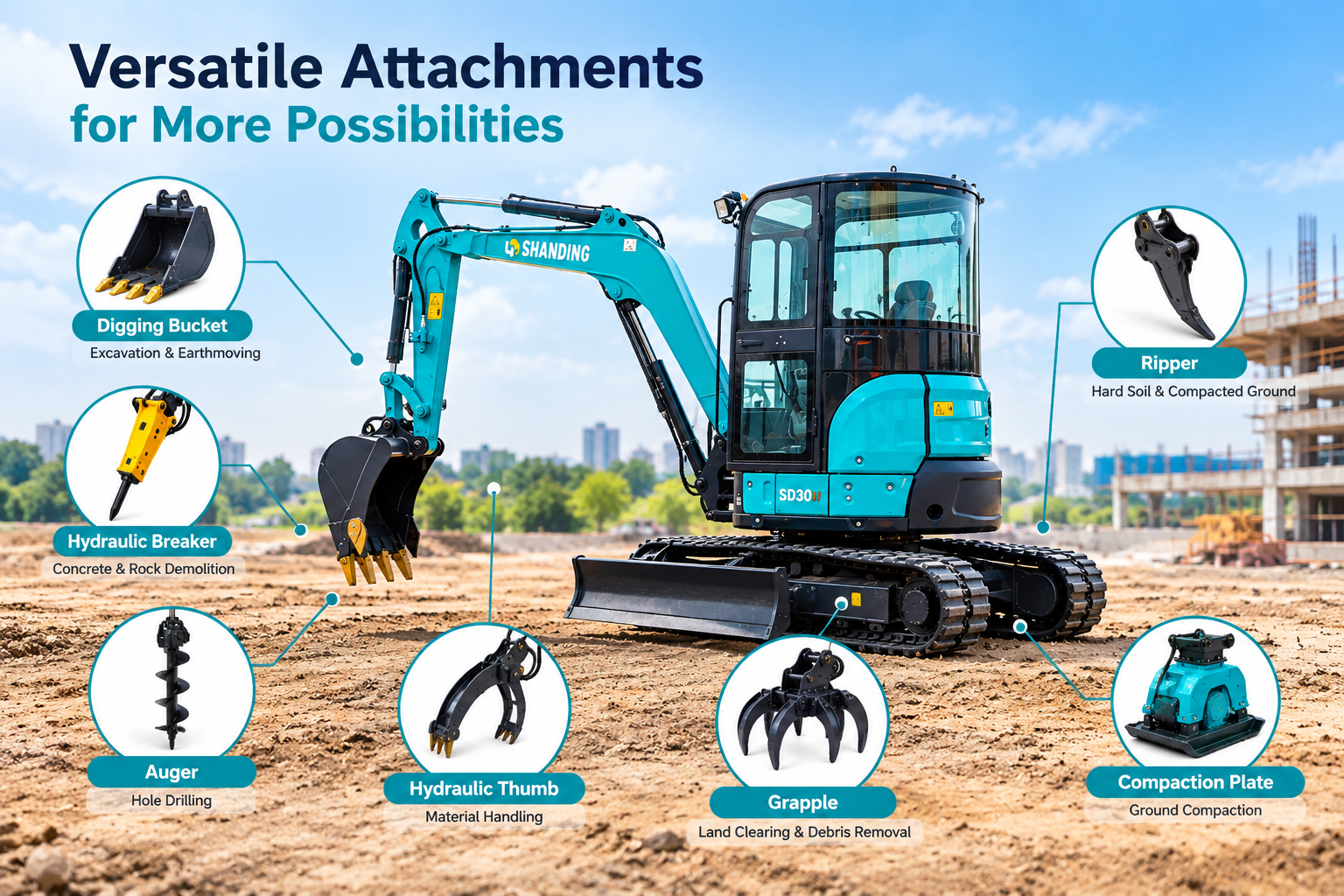
1. Digging Bucket: The Essential Attachment
The digging bucket is the most fundamental attachment for a mini excavator. It is designed for excavating soil, trenching, and general earthmoving.
Different bucket widths and tooth configurations serve different purposes:
- Standard digging bucket: Suitable for general excavation and earthmoving.
- Narrow trenching bucket: Designed for narrow trenches used in drainage and utility installation.
- Grading bucket: Features a wider profile and smooth cutting edge for leveling and finishing work.
Bucket selection directly affects excavation efficiency.
A wider bucket increases material capacity but may require greater breakout force.
The optimal bucket size depends on soil conditions, machine capacity, and the required excavation dimensions.
2. Hydraulic Breaker: For Concrete and Rock
A hydraulic breaker uses hydraulic energy to generate repeated impact forces, making it suitable for breaking concrete, asphalt, and certain types of rock.
Common applications include:
- Concrete demolition
- Road surface removal
- Foundation preparation
- Breaking compacted or rocky ground
The breaker’s performance depends on impact energy, operating frequency, hydraulic flow, and pressure.
A breaker that is too large for the carrier may impose excessive loads on the boom and structure.
Therefore, its operating weight and hydraulic requirements must match the mini excavator’s specifications.
3. Auger: For Efficient Hole Drilling
An auger is designed to drill cylindrical holes in the ground. It is particularly useful for projects requiring repeated holes with consistent diameters and depths.
Typical applications include:
- Fence post installation
- Tree planting
- Foundation pier preparation
- Utility pole installation
Auger performance depends on hydraulic torque, rotational speed, bit diameter, and soil resistance.
For harder ground, an appropriate cutting design and sufficient torque are essential.
The auger drive and bit should be selected according to the soil conditions and the machine’s available hydraulic output.
4. Hydraulic Thumb: For Material Handling
A hydraulic thumb works together with the bucket to grip and control irregular materials.
It is useful for handling:
- Rocks and concrete fragments
- Tree roots and logs
- Construction debris
- Pipes and other irregular objects
The thumb and bucket create a clamping action that improves material control.
Unlike a bucket designed primarily for excavation, a thumb allows the mini excavator to perform more precise material-handling tasks. Its installation must account for attachment geometry, hydraulic compatibility, and the machine’s lifting capacity.
5. Grapple: For Clearing and Debris Removal
A grapple uses gripping arms to collect and move materials that are difficult to handle with a conventional bucket.
It is commonly used in:
- Land clearing
- Forestry work
- Construction waste handling
- Landscaping and brush removal
Grapples improve handling efficiency by reducing the need for manual sorting and repositioning.
The appropriate grapple design depends on the material being handled.
A brush grapple is suitable for branches and vegetation, while heavier-duty configurations may be required for larger debris.
6. Ripper: For Hard and Compacted Soil
A ripper uses a concentrated tooth to penetrate and loosen hard ground before excavation.
It is suitable for:
- Compacted soil
- Hard clay
- Small roots
- Frozen ground, where machine capacity and conditions permit
The ripper concentrates the machine’s digging force into a relatively small contact area.
This increases penetration and helps reduce the resistance encountered during subsequent excavation.
For particularly hard materials, operators should confirm that the machine has sufficient breakout force and structural capacity.
7. Compaction Plate: For Ground Compaction
A hydraulic compaction plate uses vibration to densify soil and granular materials.
Typical applications include:
- Trench backfilling
- Roadbed preparation
- Foundation base compaction
- Landscaping projects
Compaction performance depends on vibration frequency, centrifugal force, contact area, soil type, and moisture content.
The correct compaction method is important because insufficient or uneven compaction can lead to settlement and reduced ground stability.
How to Choose the Right Mini Excavator Attachments
Selecting an attachment requires more than matching its appearance or nominal size to the machine.
Consider the following factors:
- Application requirements
Identify the primary task, material type, and required working dimensions.
An attachment designed for trenching may not be suitable for grading or demolition.
- Hydraulic compatibility
For powered attachments, verify the required hydraulic flow and pressure against the machine’s auxiliary hydraulic specifications.
Incorrect matching can reduce performance and cause excessive heat or component wear.
- Mounting compatibility
Check pin diameter, pin-center distance, mounting width, and quick-coupler type.
Attachments are not universally interchangeable.
- Machine capacity and stability
Attachment weight and working position affect the excavator’s stability and lifting capacity.
Always operate within the manufacturer’s specified limits.
- Frequency of use
For frequently performed tasks, owning the appropriate attachment may improve equipment utilization.
Attachments used occasionally may be more economical to rent.
Conclusion
The best mini excavator attachments depend on the type of work being performed.
For general construction, a digging bucket is essential.
A hydraulic breaker is valuable for demolition, an auger supports drilling operations, and a hydraulic thumb or grapple improves material handling.
Rippers and compaction plates further expand the machine’s capabilities.
By matching attachments to job requirements, hydraulic specifications, and operating capacity, contractors can improve productivity while maintaining safe and efficient machine operation.
Shanding mini excavators can be configured for different applications according to model specifications and available attachment options. Buyers should confirm attachment compatibility with the manufacturer before ordering.

