
China has become an important source of construction equipment for international buyers. When purchasing a mini excavator from China, however, price should not be the only consideration.
Machine specifications, manufacturer capability, quality control, export requirements, spare parts, and after-sales support can all affect the long-term value of the equipment.
Here are the key factors buyers should consider before placing an order.
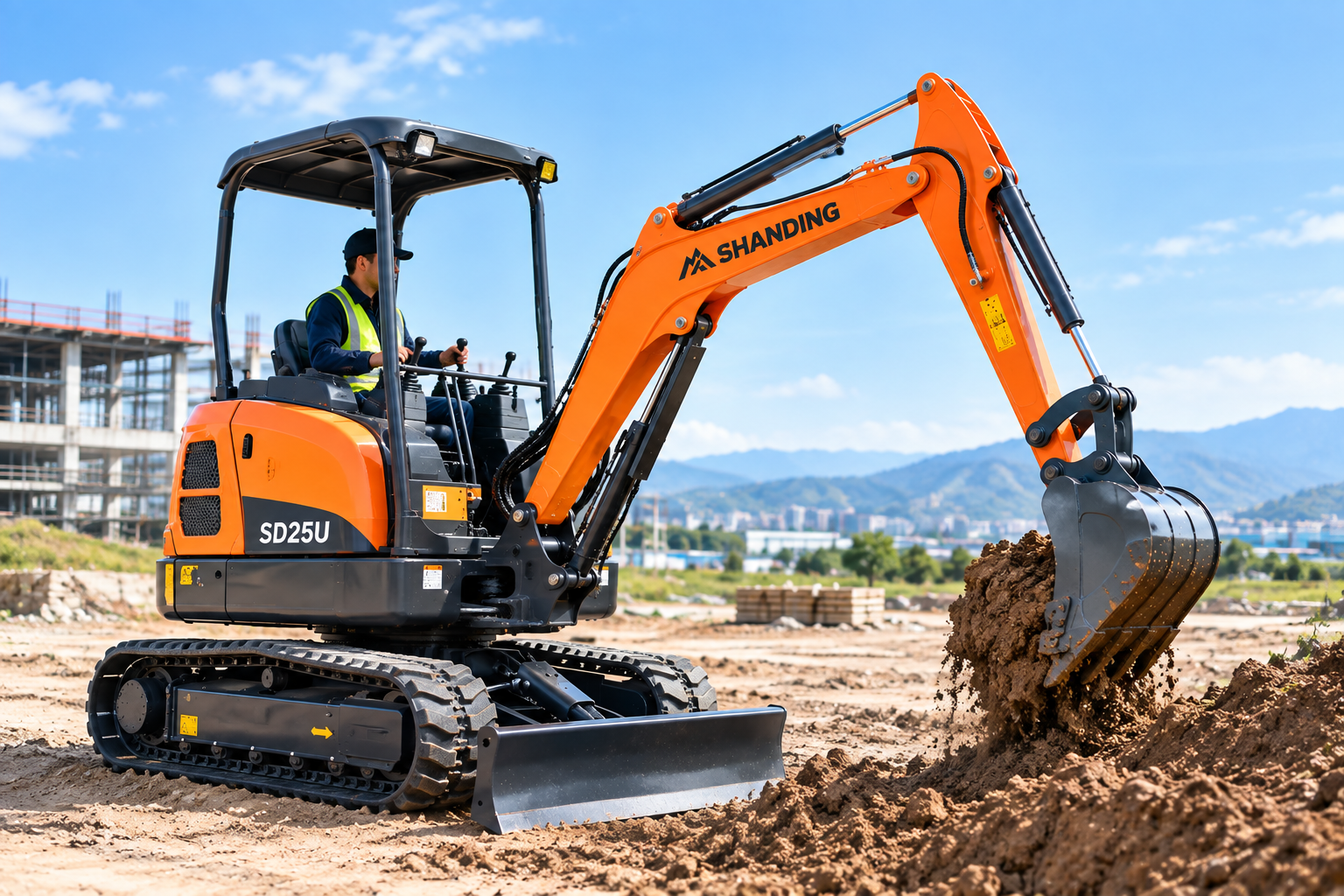
1. Match the Machine to Your Application
Start with the job rather than the machine price.
Consider the type of work, available working space, required digging depth, transport conditions, soil conditions, and expected working hours.
A compact machine may be suitable for landscaping and utility work, while heavier construction applications may require greater operating weight and hydraulic capacity.
Operating weight and dimensions also affect transportation and jobsite accessibility, so buyers should verify the actual specifications of the exact configuration being purchased.
2. Compare Specifications Carefully
Different manufacturers may use similar model names while offering different configurations.
Before comparing quotations, check the complete specification sheet.
Important factors include:
- Operating weight
- Overall width and height
- Engine model and power
- Hydraulic system
- Maximum digging depth
- Digging reach
- Bucket capacity
- Auxiliary hydraulic flow
- Track configuration
- Attachment compatibility
A machine should be evaluated as a complete system rather than by horsepower or price alone.
3.Evaluate the Manufacturer, Not Just the Product
When buying directly from China, it is important to understand who is actually manufacturing the machine.
Buyers can request the manufacturer’s company information, factory address, production photos or videos, quality-control procedures, and export experience.
A factory that can clearly explain its production process and component sourcing provides more useful information for evaluating long-term supply capability.
For larger orders, a factory audit or independent pre-shipment inspection can provide additional verification of the machine and its configuration.
4.Confirm Attachments and Hydraulic Compatibility
Attachments can significantly expand the applications of a mini excavator.
Common options include breakers, augers, grapples, grading buckets, and other specialized tools.
Before purchasing, confirm the attachment’s required hydraulic flow and pressure, mounting dimensions, machine capacity, and auxiliary connections.
Matching the hydraulic system to the attachment helps maintain stable performance and reduces unnecessary wear.
5.Consider Spare Parts and After-Sales Support
The purchase does not end when the machine arrives.
Filters, hoses, seals, bucket teeth, tracks, pins, and other wear parts may eventually need replacement.
Buyers should therefore ask about spare-parts availability, parts identification, warranty coverage, technical support, and response times before placing an order.
Good after-sales support can reduce downtime and make long-term ownership easier.
6.Calculate the Total Cost
A low factory quotation does not necessarily mean a lower overall cost.
The total purchasing cost may include the machine, attachments, inspection, export documentation, inland transportation, ocean freight, insurance, customs duties, taxes, and local delivery.
Buyers should compare quotations using the same configuration and shipping terms, such as EXW, FOB, or CIF, to avoid misleading price comparisons.
Conclusion
Buying a mini excavator from China can provide access to a wide range of machine configurations and manufacturers.
The key is to evaluate the complete purchasing process rather than focusing only on the initial price.
Before making a decision, confirm the machine’s application, specifications, manufacturer capability, quality standards, attachment compatibility, spare-parts supply, after-sales support, and total landed cost.
For overseas buyers, choosing a manufacturer that combines consistent production, clear communication, quality control, and export experience can make the purchasing process more reliable and predictable.

