
Manual digging has traditionally been used for small construction, landscaping, trenching, and agricultural projects.
However, as project efficiency and labor costs become increasingly important, many contractors are asking: Can a mini excavator replace manual digging?
In many situations, the answer is yes—but not completely.
A mini excavator can significantly reduce manual digging work, while hand tools remain useful for precision work and areas that machines cannot safely access.
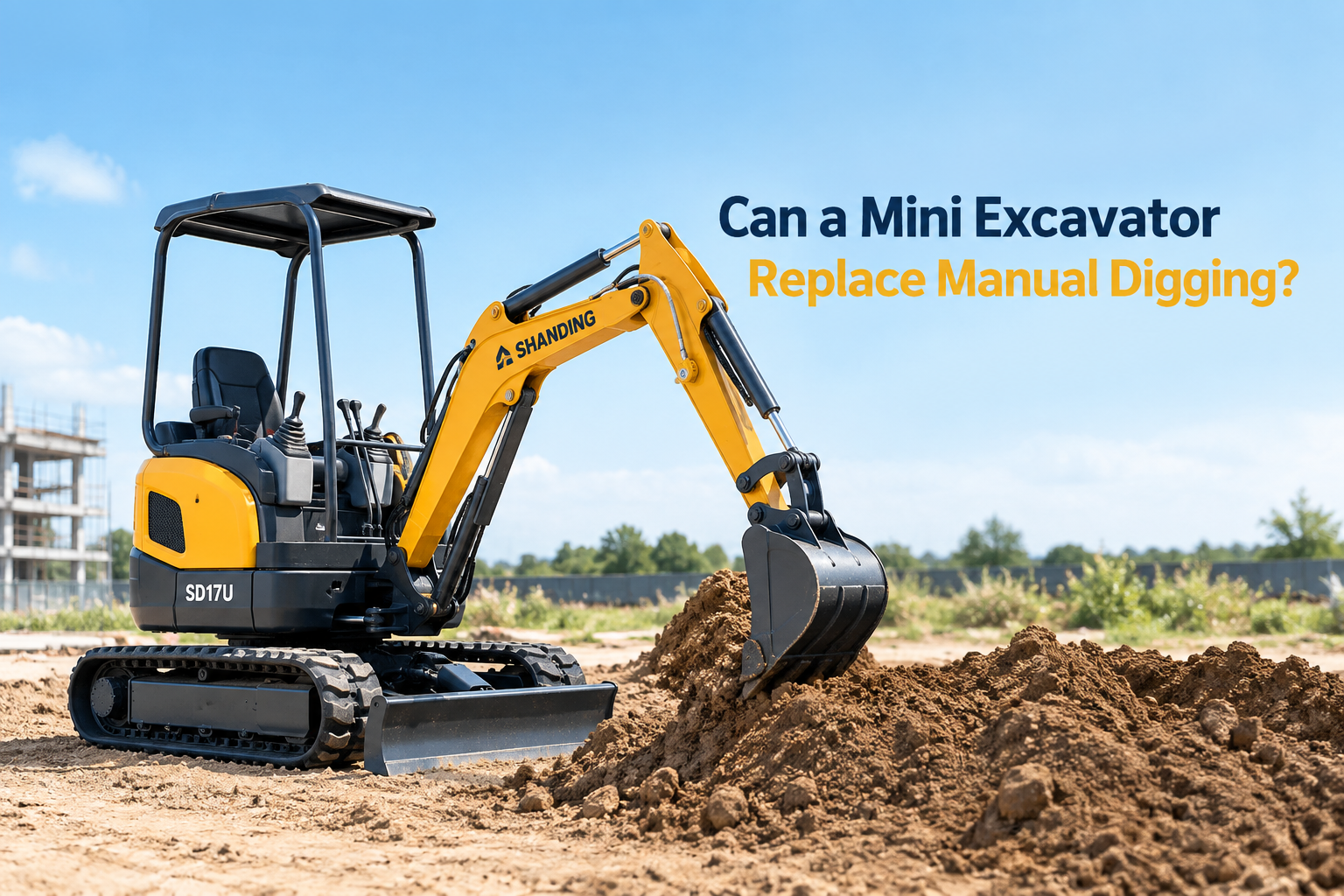
1. Higher Digging Efficiency
The biggest advantage of a mini excavator is productivity.
An operator can complete repeated digging, loading, and material-moving tasks much faster than workers using shovels and other hand tools.
The productivity advantage comes from the machine’s hydraulic system, which converts engine power into controlled digging force.
This allows the bucket to penetrate soil and move larger volumes of material with each cycle.
For trenching, foundation preparation, and earthmoving, this can substantially reduce the time required for excavation.
2. Reduced Dependence on Manual Labor
Manual excavation requires physical effort and often involves multiple workers for larger tasks.
A mini excavator can perform many of these operations with a single trained operator.
This does not necessarily eliminate labor requirements. Instead, it changes how labor is used.
Workers can focus on surveying, finishing, installation, inspection, and other tasks while the excavator handles the bulk of the excavation.
3. Better Performance in Different Soil Conditions
Soil conditions have a major influence on excavation productivity.
Loose soil can often be removed relatively easily by hand, while compacted soil, clay, gravel, and other difficult materials require considerably more effort.
A mini excavator provides mechanical digging force and hydraulic control, making it more suitable for repetitive excavation in challenging ground conditions.
However, extremely hard rock or specialized materials may require additional equipment or attachments.
4. Precision Still Matters
A mini excavator cannot completely replace manual digging when highly precise finishing is required.
For example, workers may still need to use hand tools around utility lines, existing structures, pipes, roots, or narrow areas where even a compact machine cannot operate safely.
A practical approach is therefore machine excavation followed by manual finishing.
The excavator removes most of the material, while workers perform the final adjustments.
5. When Is a Mini Excavator More Suitable?
A mini excavator can be particularly useful when a project involves:
- Repeated trench excavation
- Foundation preparation
- Landscaping and grading
- Drainage installation
- Soil removal and loading
- Residential construction
- Agricultural earthwork
For very small jobs or locations with extremely limited access, manual digging may still be more practical.
Conclusion
A mini excavator can replace a large portion of manual digging in many construction and landscaping applications, especially when excavation volume, soil resistance, and project deadlines are important factors.
The key is not necessarily to choose between machines and workers.
Using a mini excavator for bulk excavation and manual labor for precision finishing can create a more efficient workflow.
For contractors and property owners, the right solution depends on project size, ground conditions, access limitations, and the required level of excavation precision.

