
When choosing a mini excavator, many buyers focus on engine horsepower or operating weight.
However, these specifications alone do not determine how effectively a machine can penetrate and break soil.
The actual digging force is produced through the interaction of the hydraulic system, cylinders, working equipment, and mechanical linkage.
Understanding this process helps explain why two mini excavators with similar engine power can deliver different digging performance.
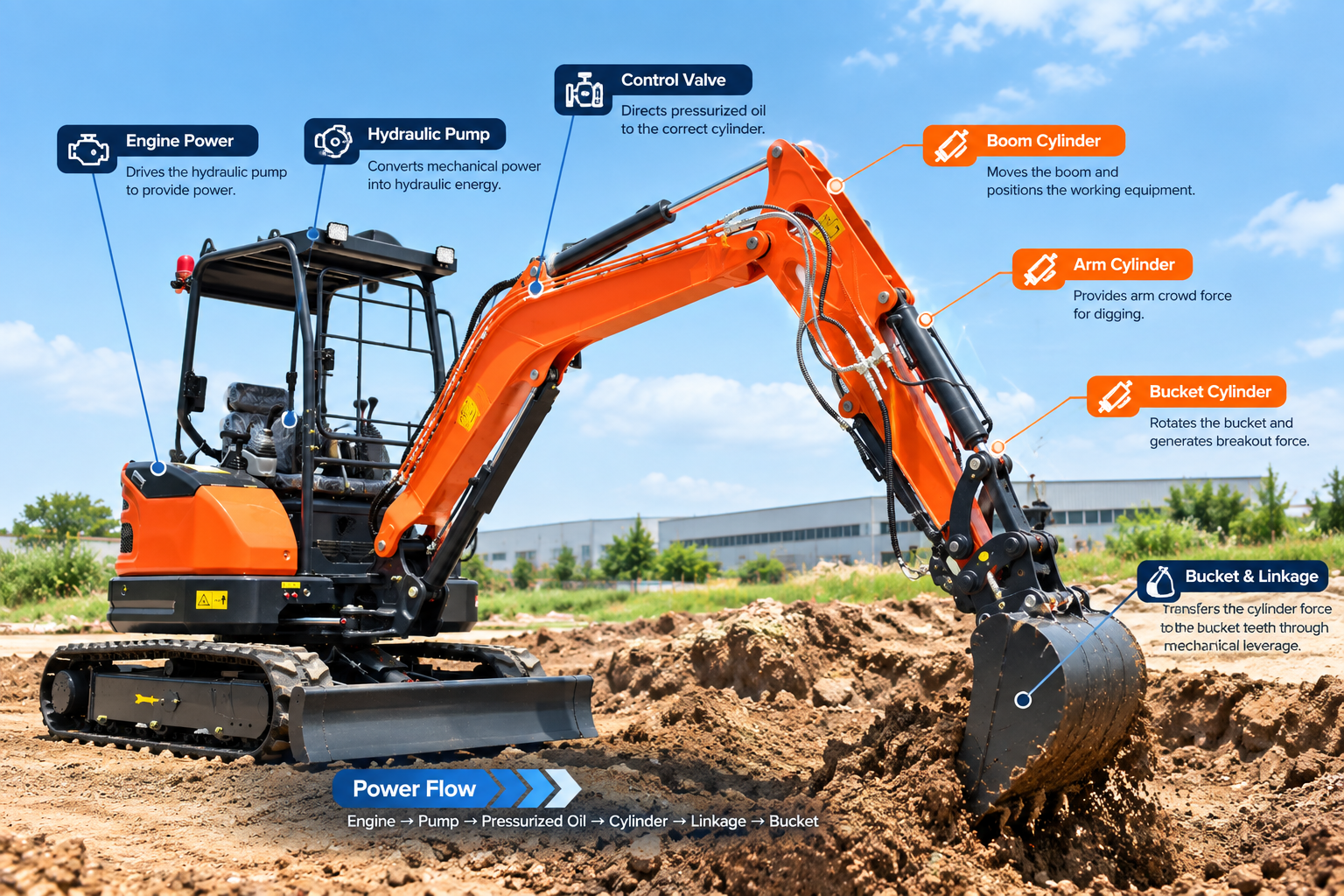
1. Engine Power Starts the Process
The engine does not directly push the bucket into the ground. Instead, it supplies mechanical power to the hydraulic pump.
The pump converts this mechanical input into hydraulic energy by circulating hydraulic oil through the system.
The control valve then directs pressurized oil to the appropriate hydraulic cylinder according to the operator’s input.
Therefore, the basic power path can be simplified as:
Engine → Hydraulic Pump → Pressurized Oil → Hydraulic Cylinder → Linkage → Bucket
This means engine horsepower is an important foundation, but it is only one part of the digging system.
2. Hydraulic Pressure Produces Cylinder Force
The hydraulic cylinder is where hydraulic energy becomes mechanical force.
The basic relationship is:
Cylinder Force = Hydraulic Pressure × Effective Piston Area
A larger piston area can generate greater cylinder force at the same hydraulic pressure.
This is why hydraulic pressure and cylinder dimensions both influence the potential digging capability of a mini excavator.
However, maximum pressure does not automatically mean maximum digging performance.
The pump, valves, cylinders and structural components must be properly matched as a complete system.
3. The Arm and Bucket Cylinders Create the Main Digging Forces
During excavation, the arm cylinder and bucket cylinder play major roles in generating digging force.
The bucket cylinder rotates the bucket through its linkage, producing bucket breakout or curling force.
The arm cylinder moves the arm and contributes arm crowd force, allowing the bucket teeth to penetrate and pull through the material.
Engineering analyses commonly calculate these forces separately because their mechanical relationships differ.
The boom cylinder mainly positions the working equipment, although boom movement can also contribute to lifting and positioning loads.
4. Mechanical Linkage Multiplies the Available Force
Hydraulic cylinder force is not transferred directly to the bucket teeth.
The force passes through pins, arms and linkages that function according to the principle of moment and leverage.
As the working angle changes, the mechanical advantage also changes.
In simplified form:
Torque = Force × Lever Arm
When the linkage reaches a favorable position, the cylinder can produce a larger effective moment at the bucket or arm.
When the geometry becomes less favorable, the force available at the bucket teeth decreases.
Research on excavator working mechanisms confirms that theoretical digging force varies with cylinder position and linkage transmission ratio.
This is why a mini excavator does not produce exactly the same digging force throughout its entire working range.
5. Bucket Geometry Also Matters
The bucket is the final component that transfers the generated force into the soil.
Bucket shape, tooth position, cutting edge geometry and bucket angle affect the resistance encountered during penetration.
A suitable bucket can reduce resistance and make better use of the machine’s available digging force.
For example, a narrow digging bucket may penetrate dense soil more easily than a wider bucket under the same machine conditions because less material must be displaced at the cutting edge.
Therefore, digging force and digging efficiency are related but not identical.
6. Why More Horsepower Does Not Always Mean More Digging Force
A common misconception is that a higher-horsepower mini excavator must have greater digging force.
In reality, digging performance depends on the complete system:
- Hydraulic working pressure
- Cylinder diameter
- Hydraulic pump capacity
- Linkage geometry
- Arm and bucket dimensions
- Machine stability
- Bucket design
- Ground resistance
Industry performance standards and manufacturer calculations typically define digging forces at specific working positions and hydraulic conditions rather than simply using engine horsepower as the determining factor.
For this reason, buyers should compare rated digging force and the hydraulic specifications rather than judging excavation capability from engine power alone.
7. The Key Is System Matching
The digging force of a mini excavator is ultimately the result of several systems working together.
A properly matched machine allows the engine, hydraulic pump, control valves, cylinders and working equipment to transfer available power efficiently to the bucket teeth.
For operators and buyers, the most useful principle is simple:
Do not evaluate digging performance from one specification.
Evaluate how the hydraulic system and mechanical structure work together.
This system-level approach provides a more accurate understanding of the real excavation capability of a mini excavator.
Conclusion
The digging force of a mini excavator is generated through a chain of energy conversion: the engine drives the hydraulic pump, hydraulic pressure produces cylinder force, and the working equipment converts that force into digging torque at the bucket.
Because linkage geometry and operating position affect mechanical advantage, digging force changes throughout the working range.
Therefore, a well-designed mini excavator is not simply one with a powerful engine, but one in which hydraulic performance, cylinder dimensions, mechanical geometry and machine stability are properly matched.
For manufacturers such as Shanding, this system-level approach is important when developing mini excavators for different working conditions and attachment requirements.

