
Which One Is Right for Your Job?
Choosing the right mini excavator is about more than operating weight and engine power. One of the most important design differences is whether the machine features zero tail swing (ZTS) or a conventional tail swing. Each design offers unique advantages depending on the working environment, project type, and operator priorities.
This guide explains the differences between the two designs and helps you determine which option best fits your needs.
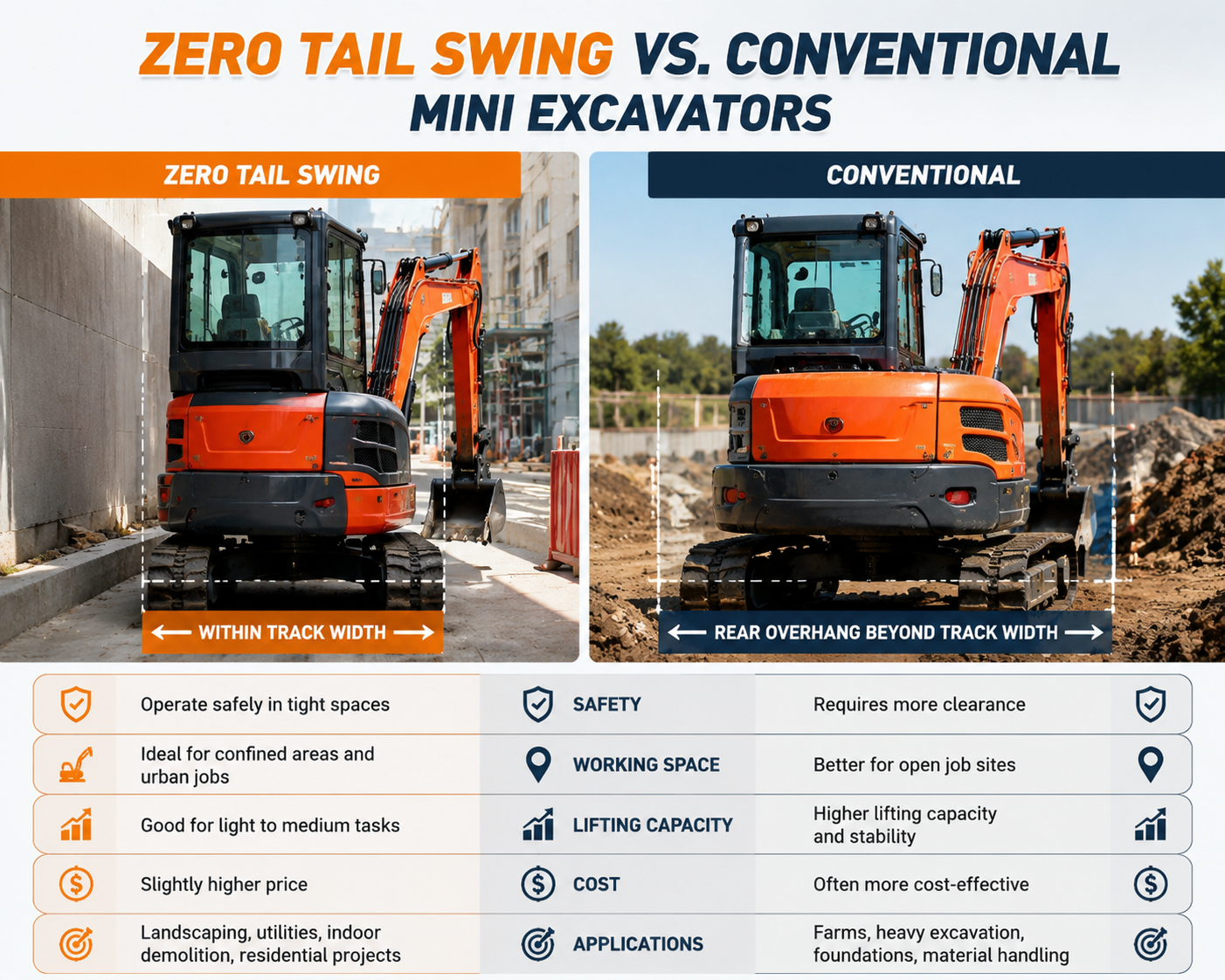
What Is a Zero Tail Swing Mini Excavator?
A zero tail swing mini excavator is designed so that the rear of the upper structure stays within the width of the tracks when the machine rotates 360 degrees. This allows operators to work safely in confined areas without the counterweight extending beyond the machine’s footprint.
Key Advantages
- Excellent for tight construction sites and urban environments.
- Reduces the risk of hitting walls, vehicles, fences, or pedestrians.
- Improves safety when working beside roads or buildings.
- Allows efficient operation in narrow trenches and residential backyards.
Typical Applications
- Landscaping
- Residential construction
- Utility installation
- Municipal maintenance
- Indoor demolition
- Roadside repair work
What Is a Conventional Mini Excavator?
A conventional mini excavator has a rear counterweight that extends beyond the tracks during rotation. This design provides additional counterbalance, improving lifting performance and overall machine stability.
Key Advantages
- Greater lifting capacity.
- Better stability when handling heavy loads.
- Stronger digging performance in demanding conditions.
- Often offers a lower purchase price for similar operating weight.
Typical Applications
- Farm work
- Heavy excavation
- Foundation digging
- Material handling
- Forestry
- Large construction sites
Key Differences Between the Two Designs
Working Space
Zero tail swing machines are designed for confined work areas where every inch matters. Conventional models require additional clearance behind the machine, making them better suited for open job sites.
Stability
Because conventional excavators use a larger rear counterweight, they generally provide better balance when lifting or digging at maximum reach. This can improve operator confidence during heavy-duty applications.
Safety
In crowded environments, zero tail swing machines reduce the chance of accidental collisions during rotation. This feature is especially valuable in residential neighborhoods and busy construction sites.
Productivity
The best choice depends on the job. A zero tail swing excavator can complete tasks faster in restricted spaces because operators spend less time repositioning the machine. On spacious sites, a conventional model may offer higher productivity thanks to its increased lifting and digging performance.
Cost
Zero tail swing excavators often involve more complex engineering to maintain stability within a compact design, which can increase manufacturing costs. Conventional machines may provide better value when working primarily in open environments.
Which Mini Excavator Should You Choose?
Choose a Zero Tail Swing Mini Excavator if you:
- Frequently work in confined spaces.
- Operate near buildings or traffic.
- Prioritize operator safety.
- Perform landscaping or residential projects.
Choose a Conventional Mini Excavator if you:
- Need maximum lifting capacity.
- Regularly handle heavy materials.
- Work on farms or large construction sites.
- Want greater stability for demanding excavation tasks.
Why Many Contractors Choose Both
Many professional contractors maintain both machine types in their fleets. A zero tail swing excavator is ideal for urban and residential jobs, while a conventional model is preferred for projects requiring greater lifting power and stability. Selecting the right machine for each application improves efficiency, reduces operating risks, and lowers overall project costs.
SHANDING Mini Excavators for Every Job
SHANDING offers both compact zero tail swing and conventional mini excavators designed for reliability, fuel efficiency, and operator comfort. Built with durable hydraulic systems, reinforced structures, and versatile attachment compatibility, our machines deliver dependable performance across construction, landscaping, agriculture, and municipal applications.
Whether you need superior maneuverability in tight spaces or maximum stability for heavy-duty work, SHANDING provides solutions that help you complete projects efficiently and confidently.
Conclusion
Neither zero tail swing nor conventional mini excavators is universally better. The ideal choice depends on your workspace, lifting requirements, and daily applications. Understanding the engineering differences allows buyers to select equipment that delivers higher productivity, improved safety, and better long-term value.

