
When it comes to earthmoving equipment, two machines are often compared by contractors, landscapers, and property owners: the mini excavator and the backhoe.
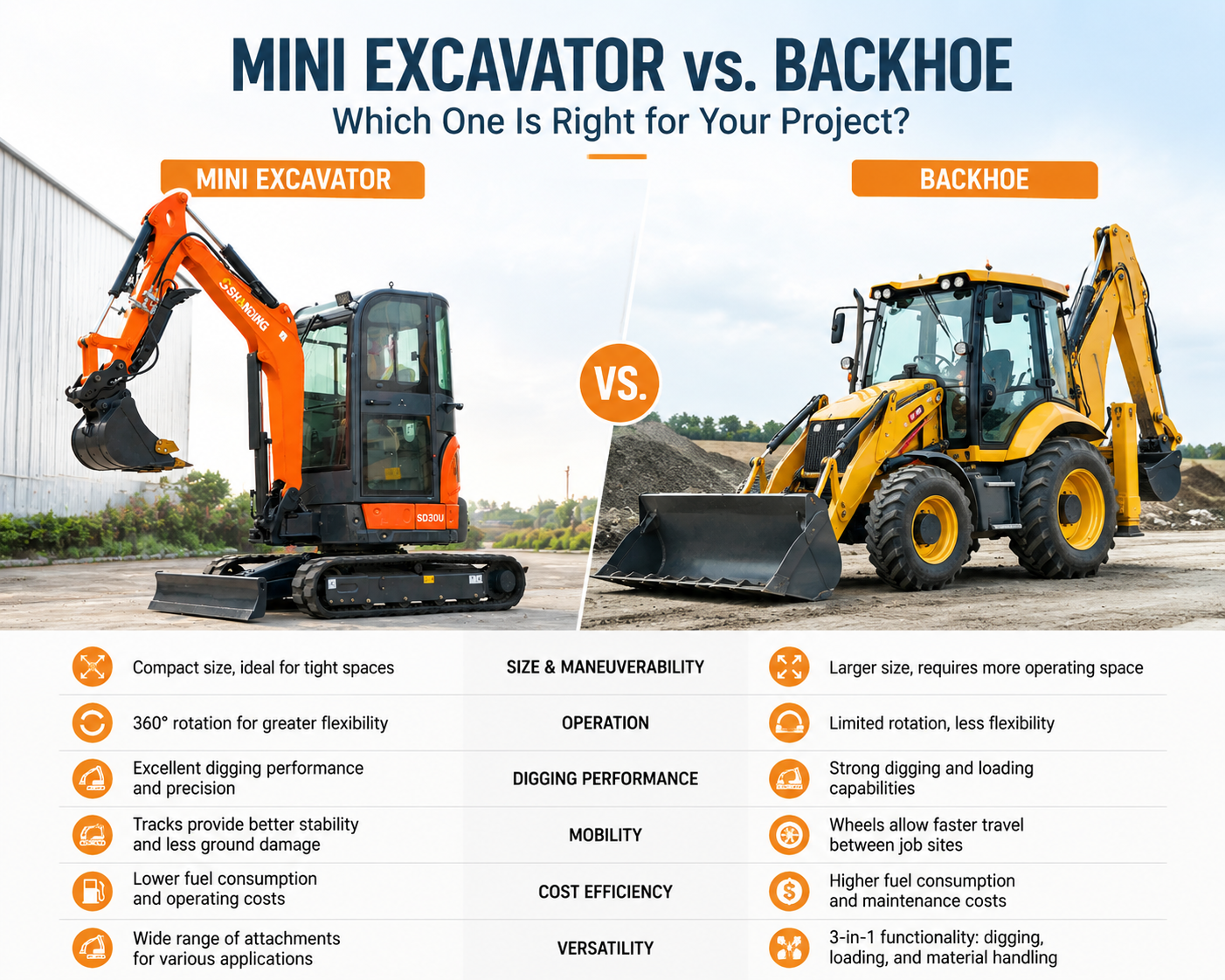
While both are designed for digging and material handling, they differ significantly in design, functionality, efficiency, and ideal applications.
Understanding these differences can help you make a smarter investment and improve productivity on the job site.
In this guide, we’ll explore how mini excavators and backhoes compare, and why many professionals are increasingly choosing compact excavators for modern projects.
What Is a Mini Excavator?
A mini excavator, also known as a compact excavator, is a small tracked machine specifically designed for excavation, trenching, grading, and demolition work in confined spaces.
Mini excavators typically weigh between 1 and 10 tons and consist of:
- A rotating cab
- Boom and arm assembly
- Hydraulic bucket
- Tracked undercarriage
- Compact chassis
One of the biggest advantages of a mini excavator is its ability to rotate 360 degrees without repositioning the machine, making it highly efficient in tight working environments.
What Is a Backhoe?
A backhoe loader combines three machines into one: A tractor A front loader bucket A rear digging arm (backhoe) Unlike a mini excavator, a backhoe travels on wheels and is designed to perform multiple tasks, including digging, loading, lifting, and transporting materials.
Backhoes are commonly used in road construction, municipal projects, agricultural operations, and utility maintenance where mobility between work locations is important.
Key Differences Between Mini Excavators and Backhoes
1. Machine Design
Mini excavators are purpose-built digging machines.
Their compact design focuses on excavation performance and maneuverability.
Backhoes are multi-purpose machines that combine excavation and loading functions in a single unit.
Winner for digging efficiency: Mini Excavator
2. Mobility
Backhoes travel on wheels and can move quickly between job sites without requiring a trailer for short distances.
Mini excavators use tracks, which provide excellent traction and stability but generally require transportation equipment when moving between locations.
Winner for road mobility: Backhoe
3.Working in Tight Spaces
Construction projects are increasingly taking place in residential neighborhoods, urban developments, and landscaped areas where space is limited.
Mini excavators excel in these conditions because of:
- Compact dimensions
- Zero-tail swing options
- 360-degree rotation
- Lower ground pressure
Backhoes require more operating space and have a larger turning radius.
Winner for confined spaces: Mini Excavator
4. Digging Performance
Although larger backhoes can reach impressive digging depths, mini excavators often provide greater precision and efficiency for detailed excavation work.
The hydraulic systems on modern compact excavators deliver excellent breakout force while maintaining smooth operation.
Mini excavators are particularly effective for:
- Foundation digging
- Utility trenching
- Landscaping projects
- Drainage installation
- Small demolition tasks
Winner for precision excavation: Mini Excavator
Which Machine Should You Choose?
Choose a mini excavator if your work primarily involves:
- Residential construction
- Landscaping
- Trenching
- Utility installation
- Small demolition projects
- Farm maintenance
- Work in confined spaces
Choose a backhoe if you need:
- Frequent road travel
- Material loading and transportation
- Large municipal projects
- General-purpose construction equipment
Why More Contractors Are Choosing Mini Excavators
Industry trends show increasing demand for compact construction equipment. As urban development grows and job sites become more restricted, contractors need machines that deliver maximum productivity in limited spaces.
Modern mini excavators offer:
- Powerful hydraulic performance
- Advanced operator comfort
- Improved fuel efficiency
- Multiple attachment options
- Lower ownership costs
For many contractors, a compact excavator provides the best balance between performance, flexibility, and return on investment.
The Shanding Advantage
At Shanding, we design mini excavators to meet the needs of modern construction, landscaping, agricultural, and utility professionals.
Our compact excavators deliver:
- Reliable hydraulic power
- Durable structural design
- Easy maintenance
- Fuel-efficient operation
- Versatile attachment compatibility
Whether you’re digging foundations, installing utilities, or maintaining agricultural land, Shanding mini excavators help you complete projects more efficiently and cost-effectively.
Conclusion
Both mini excavators and backhoes are valuable pieces of equipment, but they serve different purposes.
If your priority is mobility and multi-function capability, a backhoe may be the right choice.
However, if you need superior digging performance, precision, lower operating costs, and the ability to work in confined spaces, a mini excavator is often the better investment.
As construction projects continue to demand greater efficiency and flexibility, compact excavators are becoming the preferred solution for contractors worldwide.
Looking for a reliable mini excavator for your next project? Contact Shanding today to explore our range of high-performance compact excavators.

